
 パソコ
パソコこんにちは!パソコです。気になったら関連記事もチェックしてみてね🔥
On December 27, 2023 — a quiet weekday at the end of the year — I made a day trip to Nara while passing through Osaka on my way back to my hometown. My gamble that “it’ll be less crowded on a weekday” paid off completely: I had the Great Buddha Hall almost entirely to myself.
Getting There: Mt. Fuji from the Shinkansen
I left Tokyo early in the morning and headed west on the Shinkansen. Just past Shizuoka, Mt. Fuji appeared in the window — snow-capped, crisp against the winter sky.
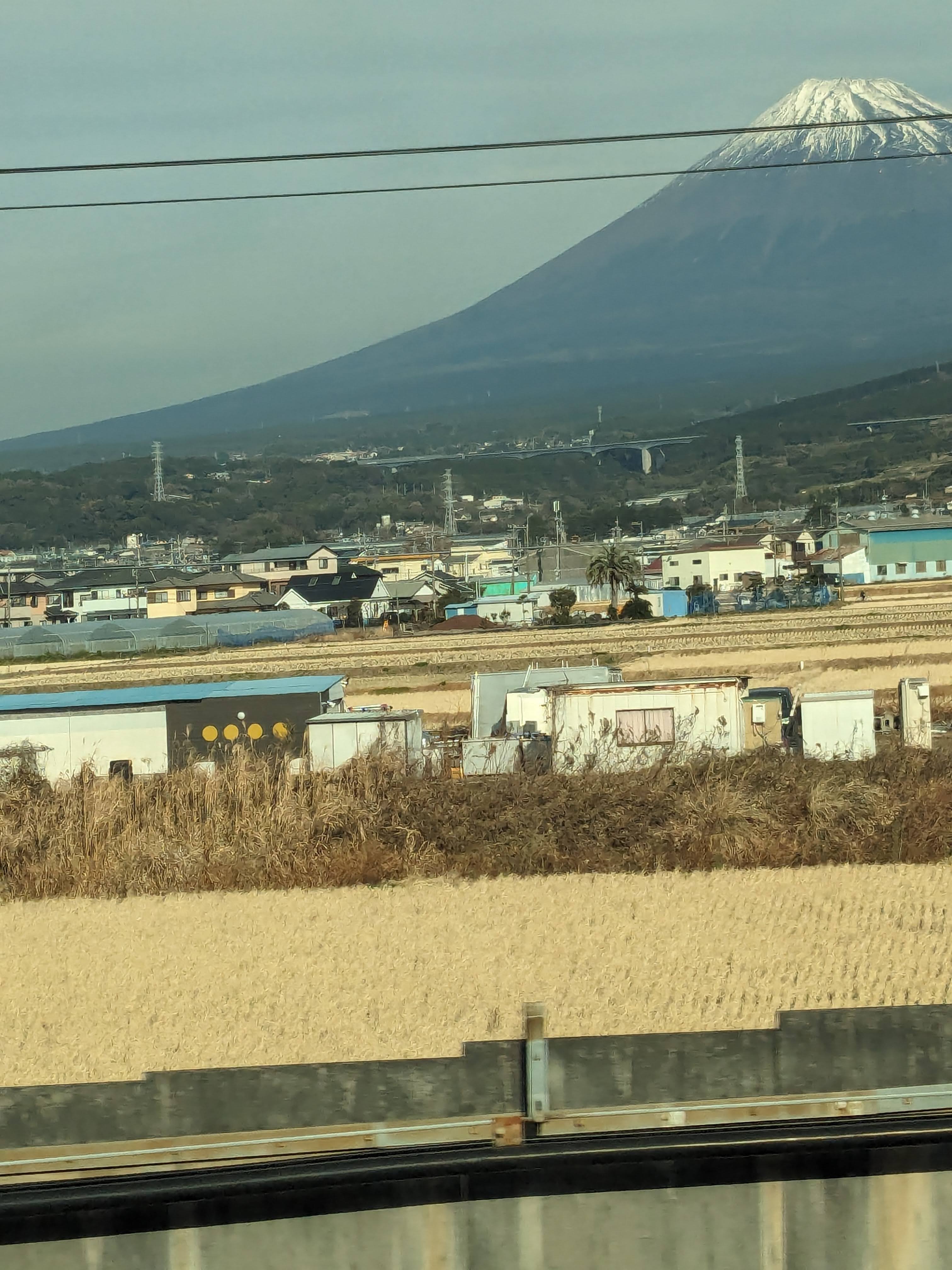 ▲ Mt. Fuji from the Shinkansen window
The perfect send-off for a Nara day trip
▲ Mt. Fuji from the Shinkansen window
The perfect send-off for a Nara day trip
After switching to the Kintetsu Line in Osaka, I arrived at Kintetsu-Nara Station in about 35 minutes. Osaka to Nara — closer than I expected.
Deer Before I Even Reached the Park
A few minutes’ walk from the station, I was already encountering deer. Right in front of the Nara Prefectural Government building — a thoroughly modern glass-and-concrete structure — two deer were placidly grazing on the lawn.
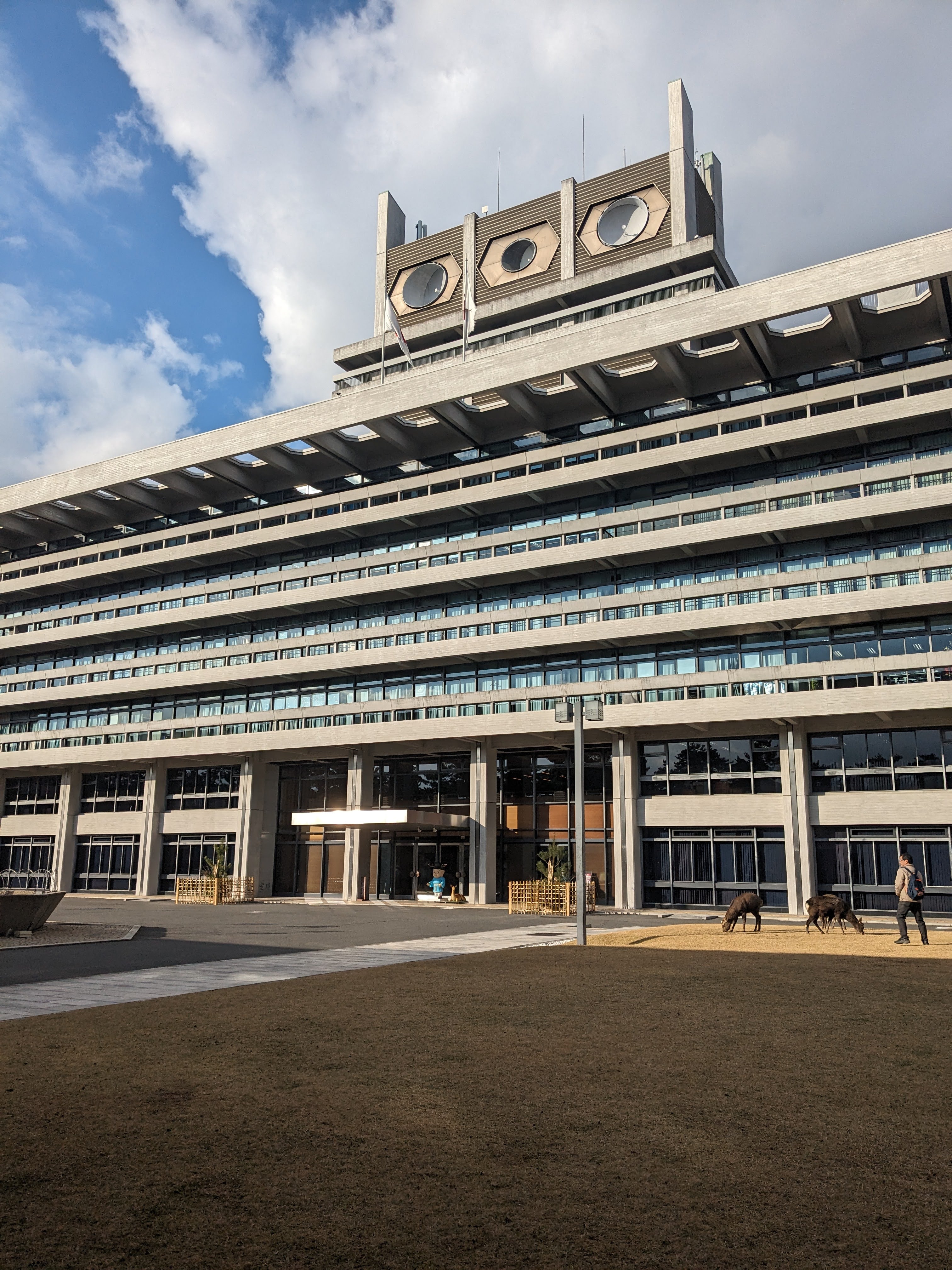 ▲ Deer near the Nara government building
Modern architecture, ancient deer. Classic Nara
▲ Deer near the Nara government building
Modern architecture, ancient deer. Classic Nara
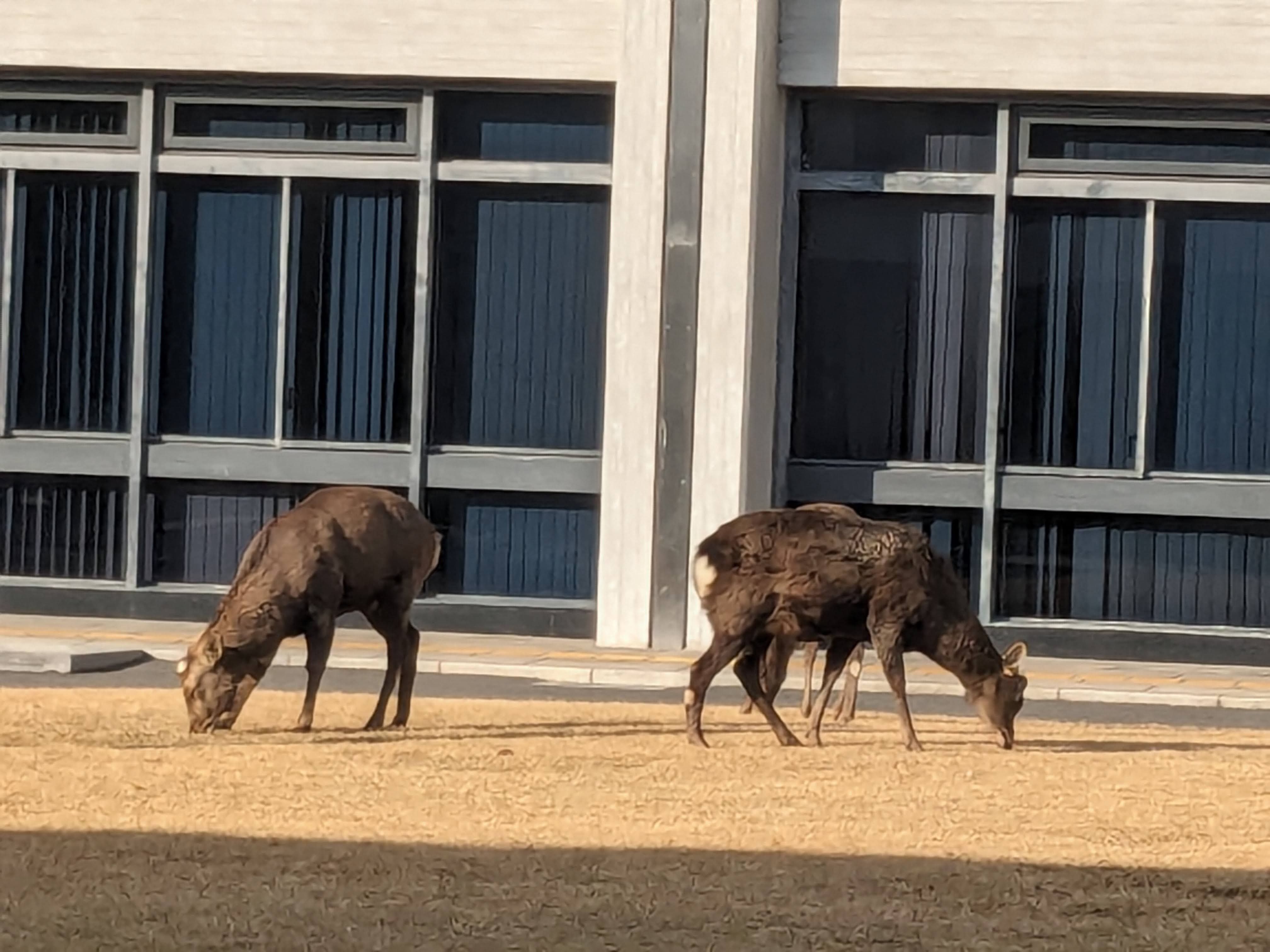 ▲ Close-up of the deer
Two deer side by side, utterly unbothered by the humans around them
▲ Close-up of the deer
Two deer side by side, utterly unbothered by the humans around them
Roughly 1,300 deer roam freely through Nara Park and the surrounding area. Protected as a natural treasure and considered sacred messengers of the gods, they go where they please — and they know it.
Into the Precinct: Stone Monuments and Quiet Streams
Walking toward Todaiji, I passed stone monuments along the approach road.
 ▲ Stone monument near Todaiji
Carved stone markers marking the way toward the temple
▲ Stone monument near Todaiji
Carved stone markers marking the way toward the temple
Just off the path, a small stream and garden appeared. A lone deer was resting on the bank, completely still.
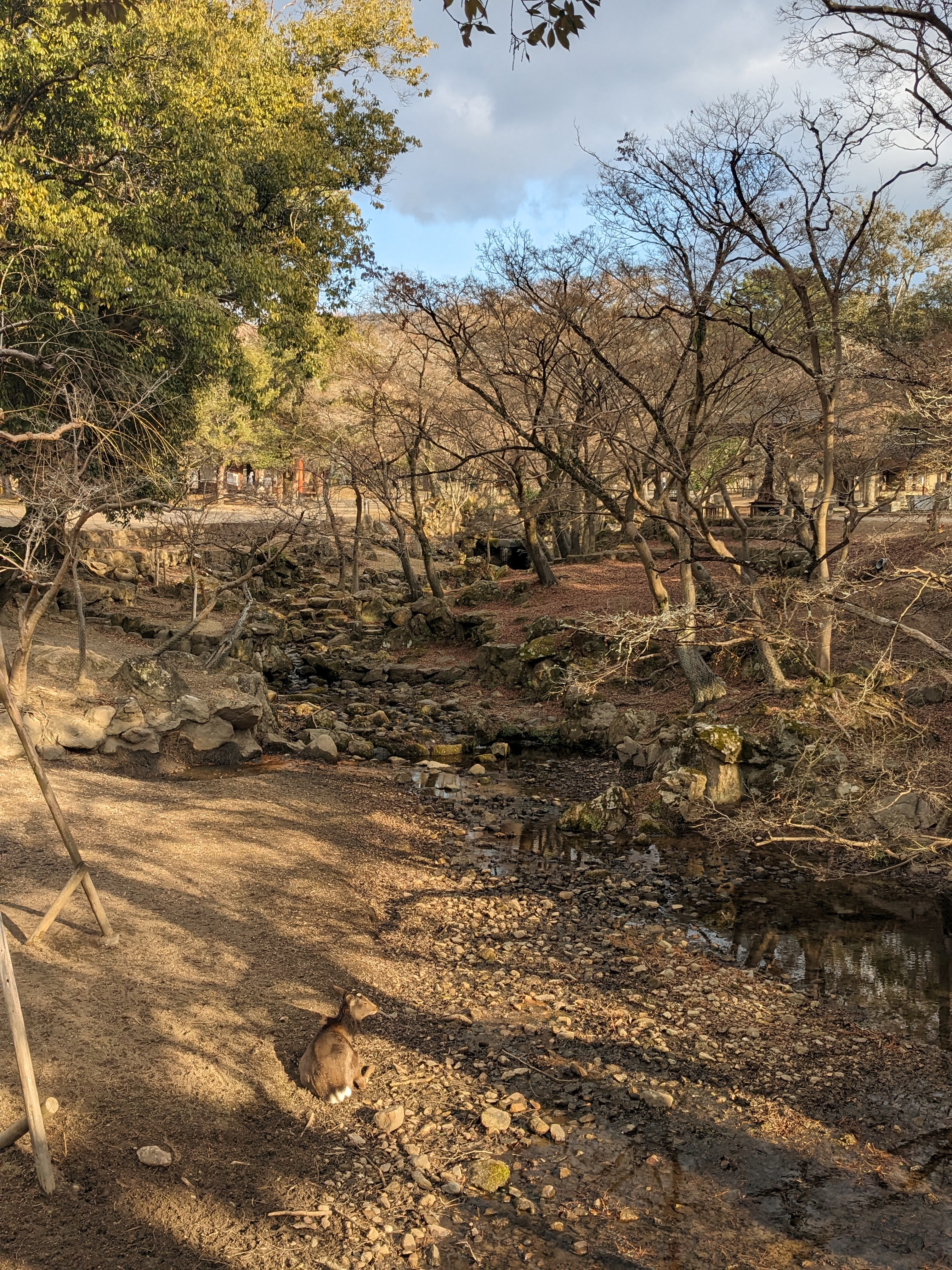 ▲ Stream and resting deer in Nara Park
One of those quiet scenes that stop you mid-stride
▲ Stream and resting deer in Nara Park
One of those quiet scenes that stop you mid-stride
Nandaimon Gate: The Nio Guardians Up Close
Todaiji’s south gate, the Nandaimon, stands 25.46 meters tall — a structure that registers in the body before it registers in the mind. You feel the scale before you process it.
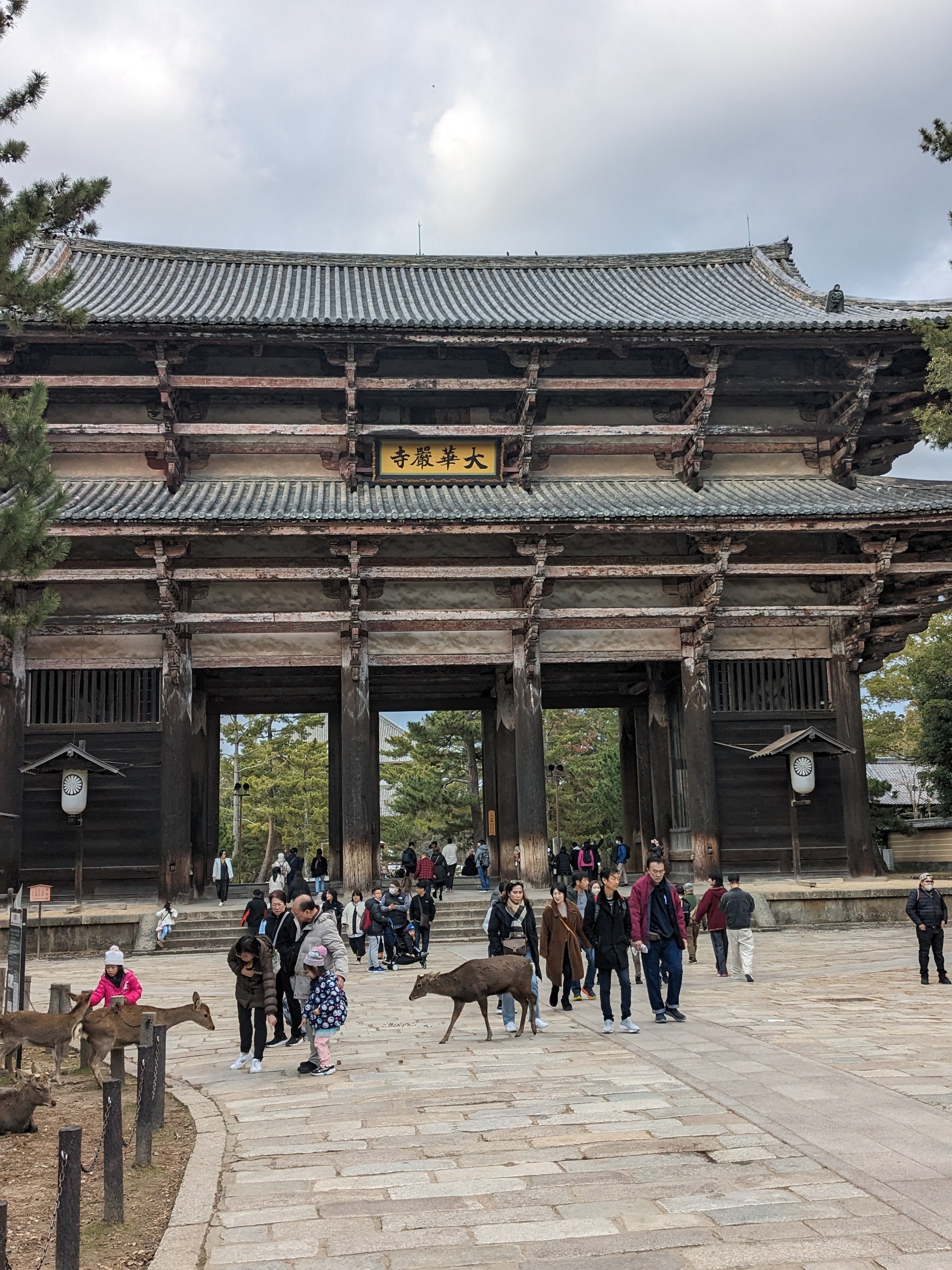 ▲ Nandaimon Gate full view
The Nandaimon, with deer wandering in front as tourists pass through
▲ Nandaimon Gate full view
The Nandaimon, with deer wandering in front as tourists pass through
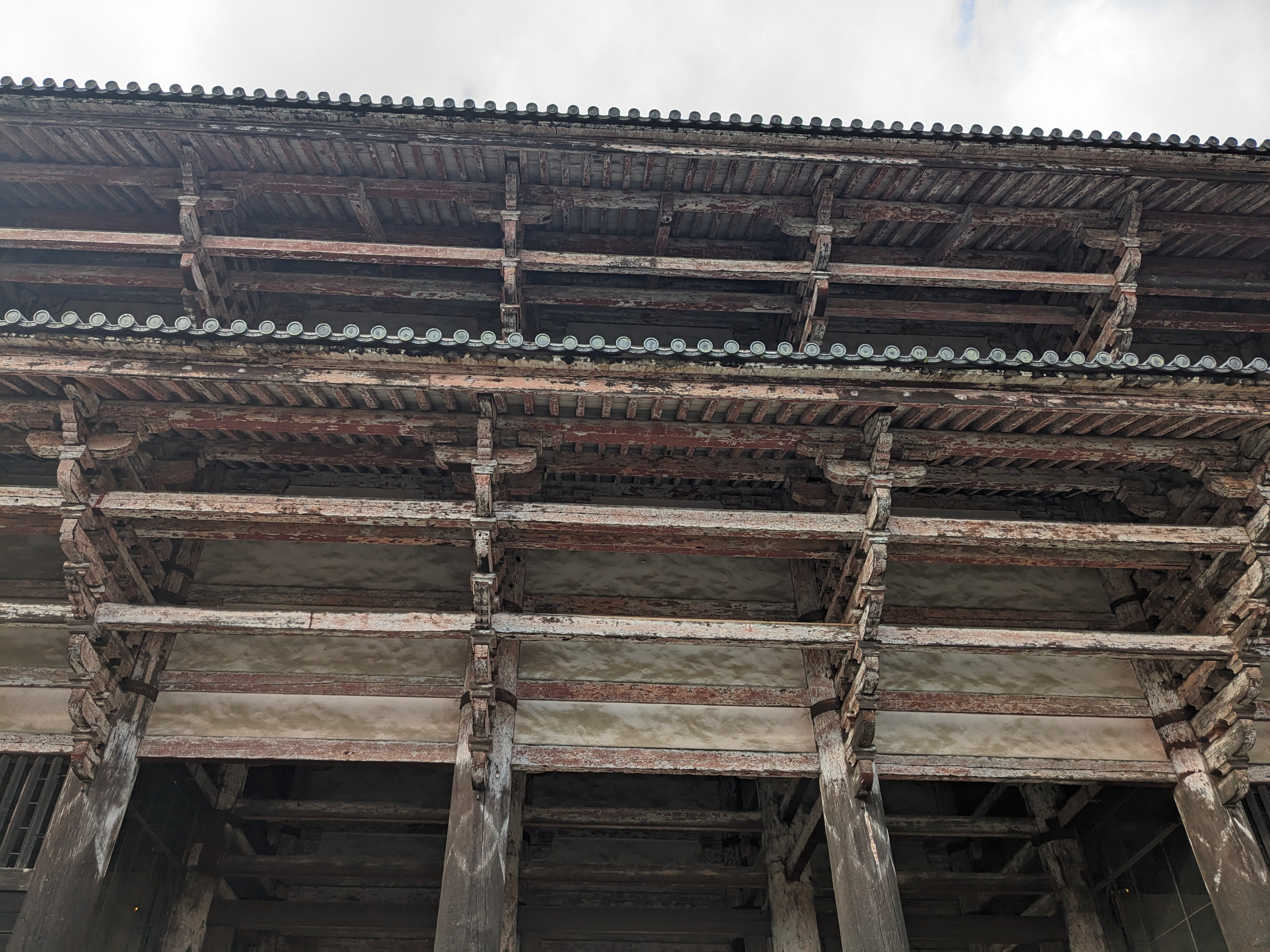 ▲ Nandaimon roof detail
The exposed bracket system of the Daibutsuyō (Indian/Tenjiku-style) architecture
▲ Nandaimon roof detail
The exposed bracket system of the Daibutsuyō (Indian/Tenjiku-style) architecture
Flanking the gate on both sides are the Nio — two guardian figures carved in the Kamakura period (around 1203) by the sculptor Unkei and his colleagues. Each stands about 8.4 meters. Even viewed through wire mesh, they’re extraordinary.
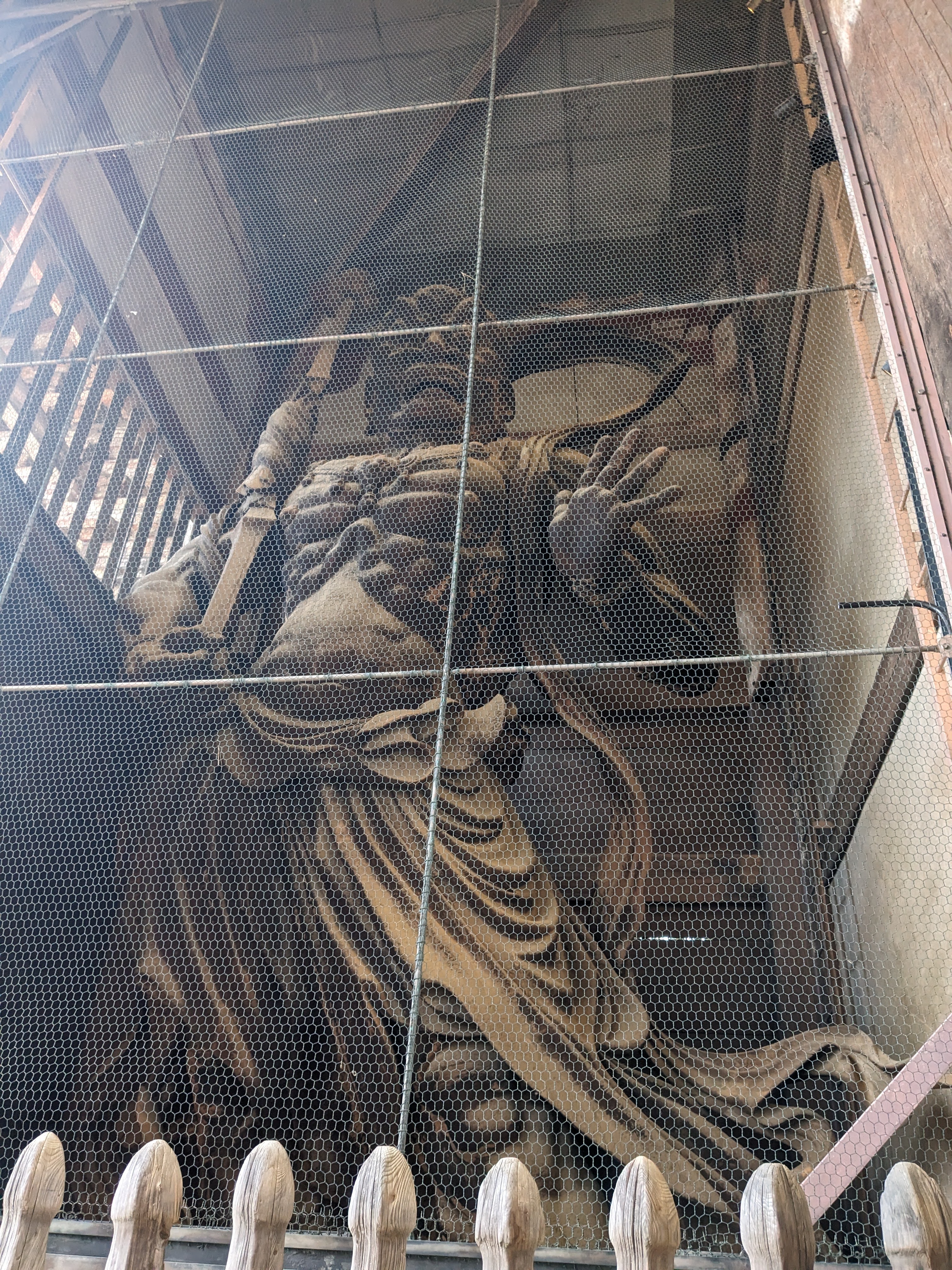 ▲ Agyo Nio guardian (mouth open)
The Agyo guardian, mouth open. The musculature is almost uncomfortably realistic
▲ Agyo Nio guardian (mouth open)
The Agyo guardian, mouth open. The musculature is almost uncomfortably realistic
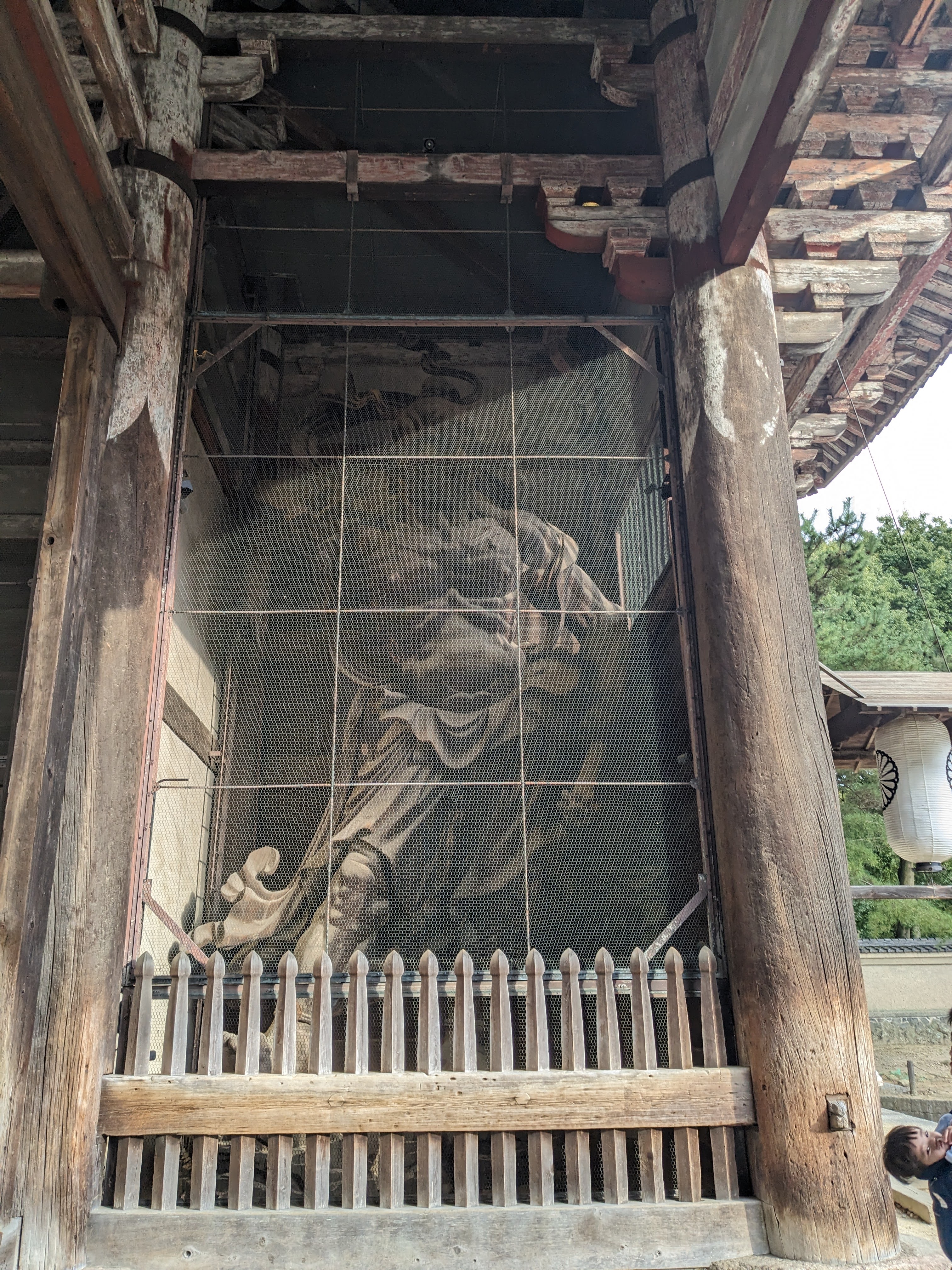 ▲ Ungyo Nio guardian (mouth closed)
The Ungyo guardian, mouth closed. Fierce in a different, somehow more interior way
▲ Ungyo Nio guardian (mouth closed)
The Ungyo guardian, mouth closed. Fierce in a different, somehow more interior way
Todaiji Museum: The Buddha’s Hand in Your Hand
Just outside the Great Buddha Hall, the Todaiji Museum displays artifacts from the temple. At the entrance: a full-scale replica of one of the Great Buddha’s hands.
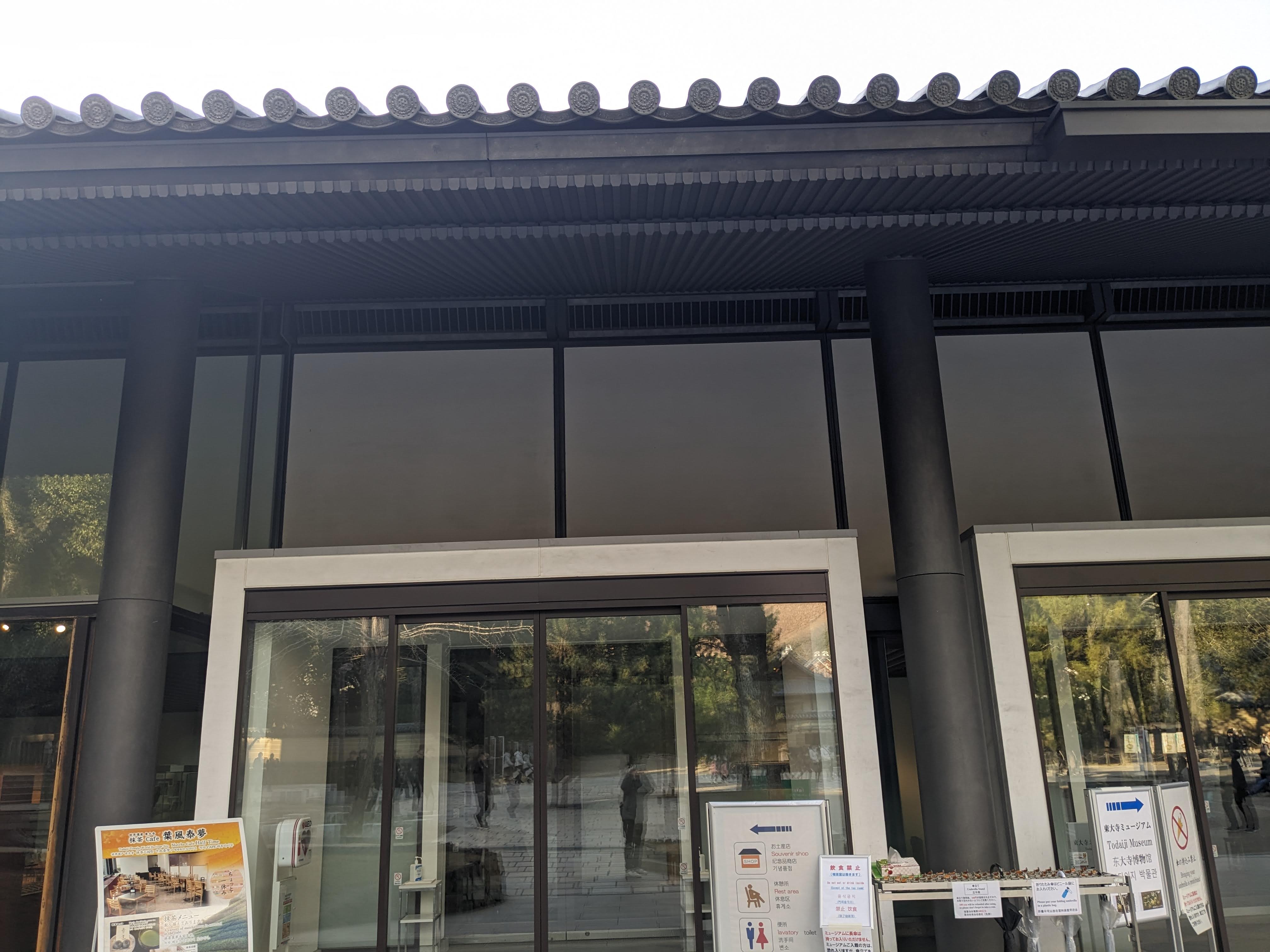 ▲ Todaiji Museum entrance
The museum entrance — easy to miss, worth stopping for
▲ Todaiji Museum entrance
The museum entrance — easy to miss, worth stopping for
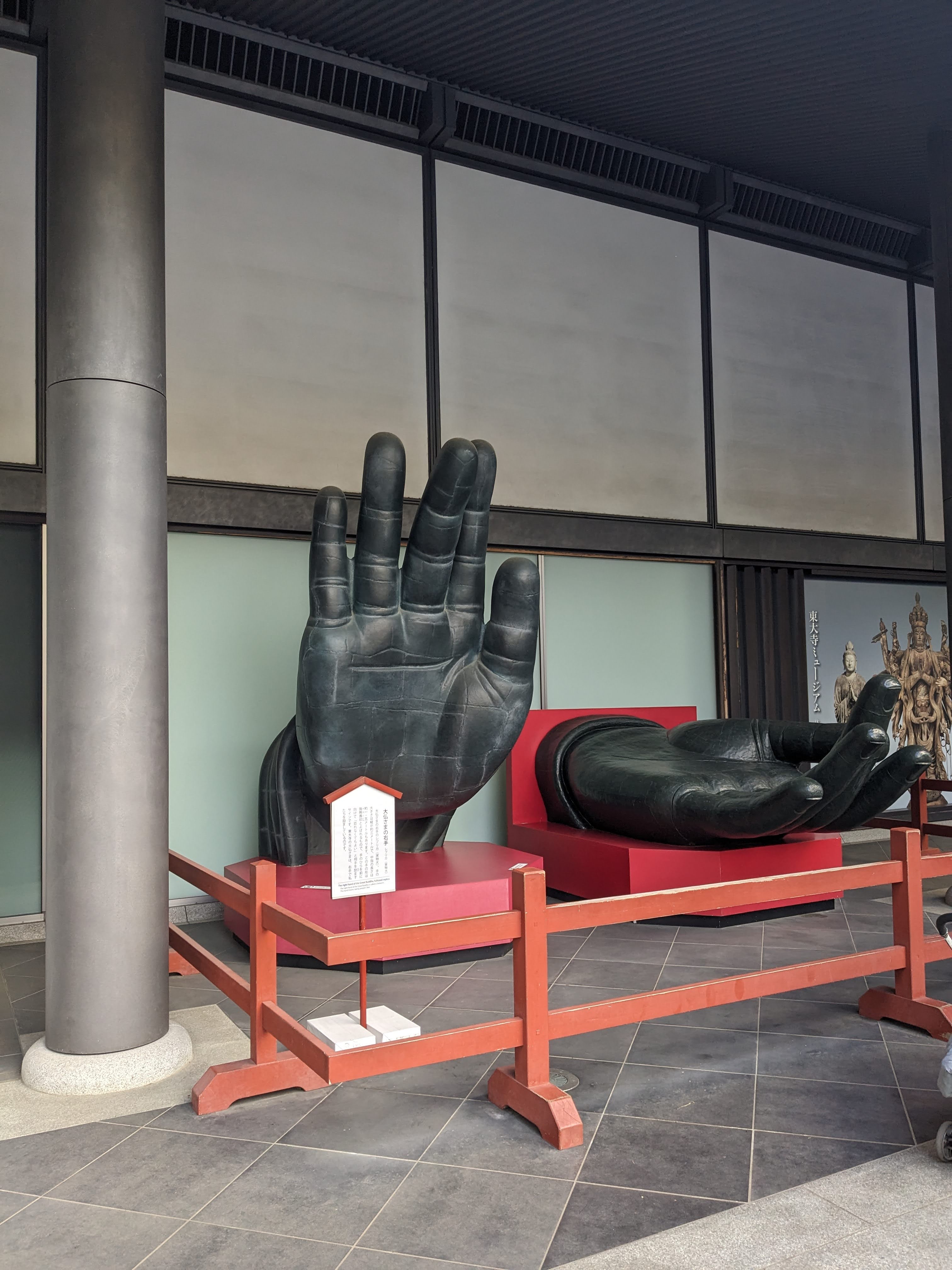 ▲ Replica of the Great Buddha’s hand
The hand alone is roughly 2.5 meters long. It’s one thing to read that fact; it’s another to stand next to it
▲ Replica of the Great Buddha’s hand
The hand alone is roughly 2.5 meters long. It’s one thing to read that fact; it’s another to stand next to it
The Great Buddha Hall: World’s Largest Wooden Structure
Past the middle gate (Chūdaimon), the full facade of the Daibutsuden comes into view. Width 57 meters, height 48 meters. The current building dates from the Edo period — and it’s actually smaller than previous versions.
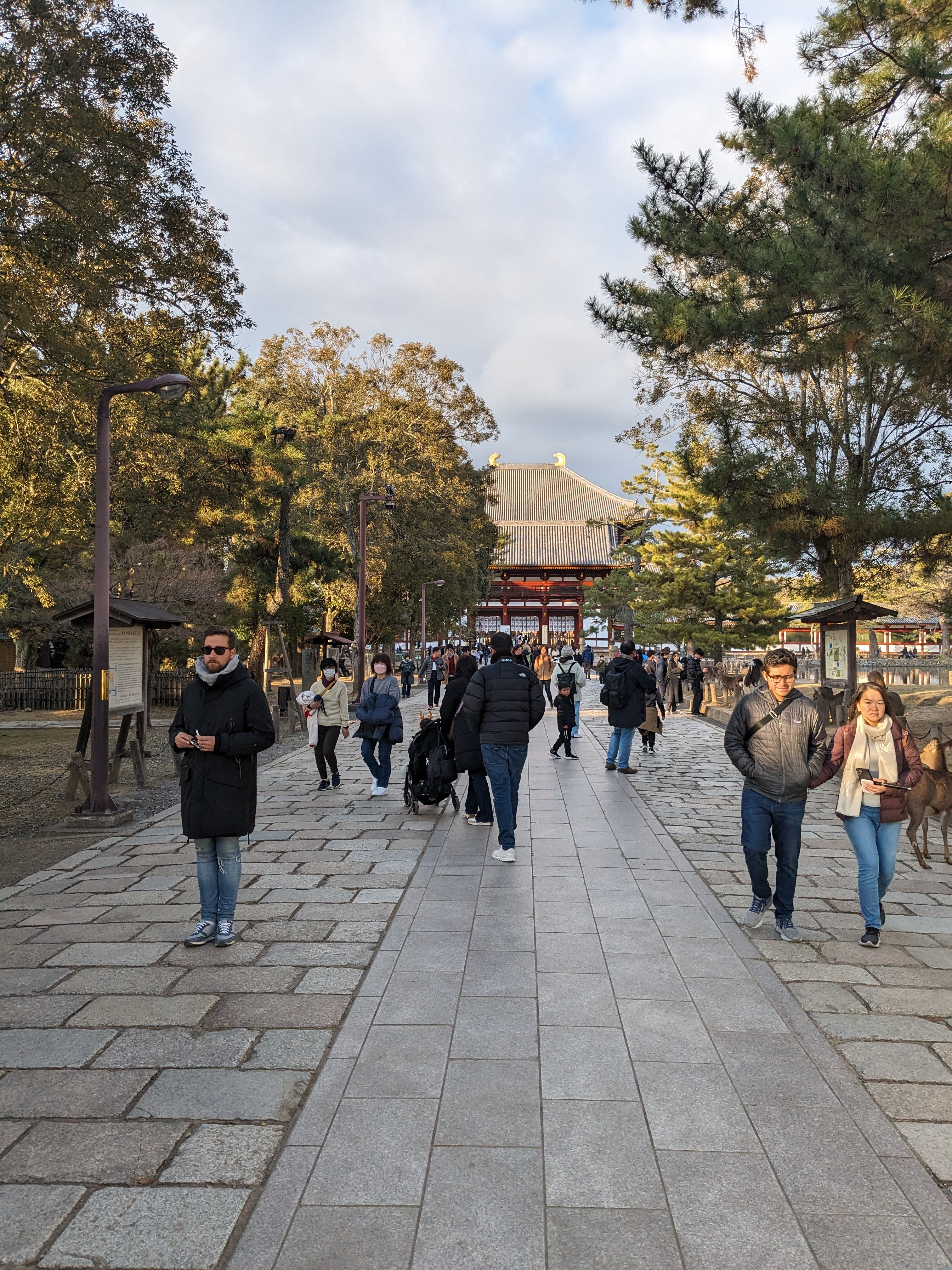 ▲ Approach path and middle gate
The approach toward Chūdaimon and the Great Buddha Hall beyond
▲ Approach path and middle gate
The approach toward Chūdaimon and the Great Buddha Hall beyond
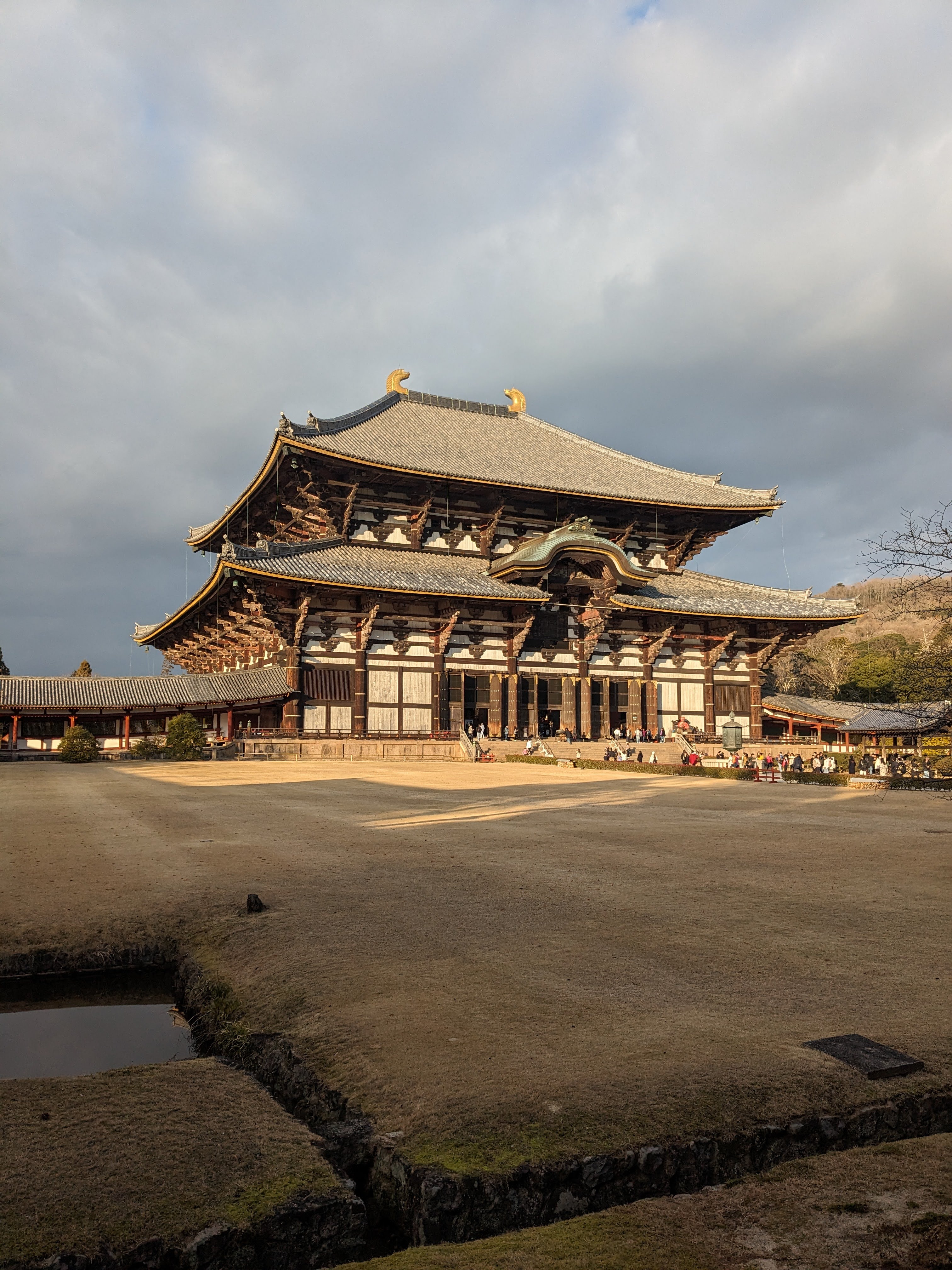 ▲ Daibutsuden exterior
Winter afternoon light on the Daibutsuden. Calm, enormous, unmistakable
▲ Daibutsuden exterior
Winter afternoon light on the Daibutsuden. Calm, enormous, unmistakable
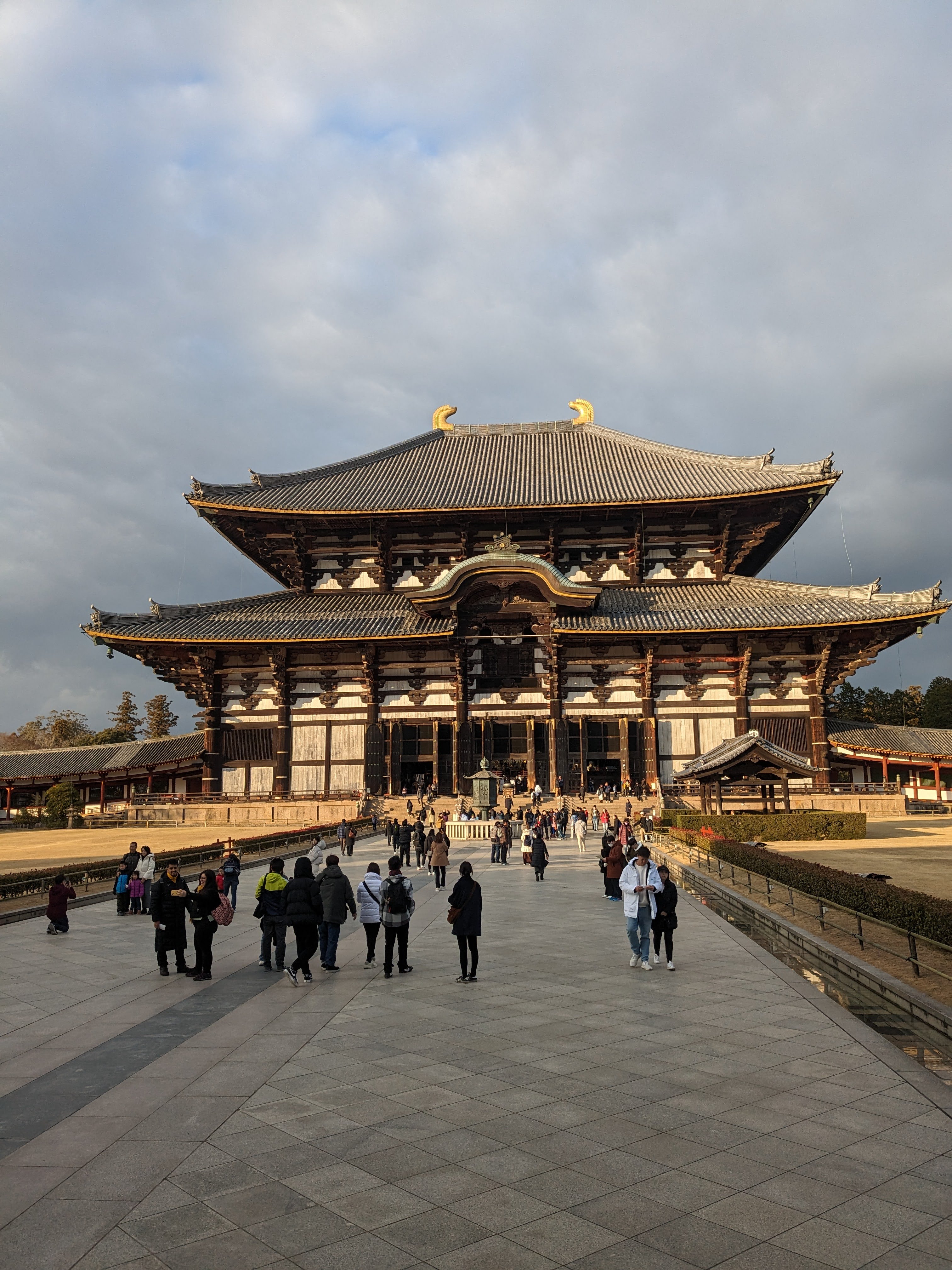 ▲ Visitors approaching the hall
December weekday foot traffic — sparse enough to move at my own pace
▲ Visitors approaching the hall
December weekday foot traffic — sparse enough to move at my own pace
Inside the Daibutsuden: The Great Buddha and Its Companions
Admission is ¥600. Step inside and the architecture hits you first.
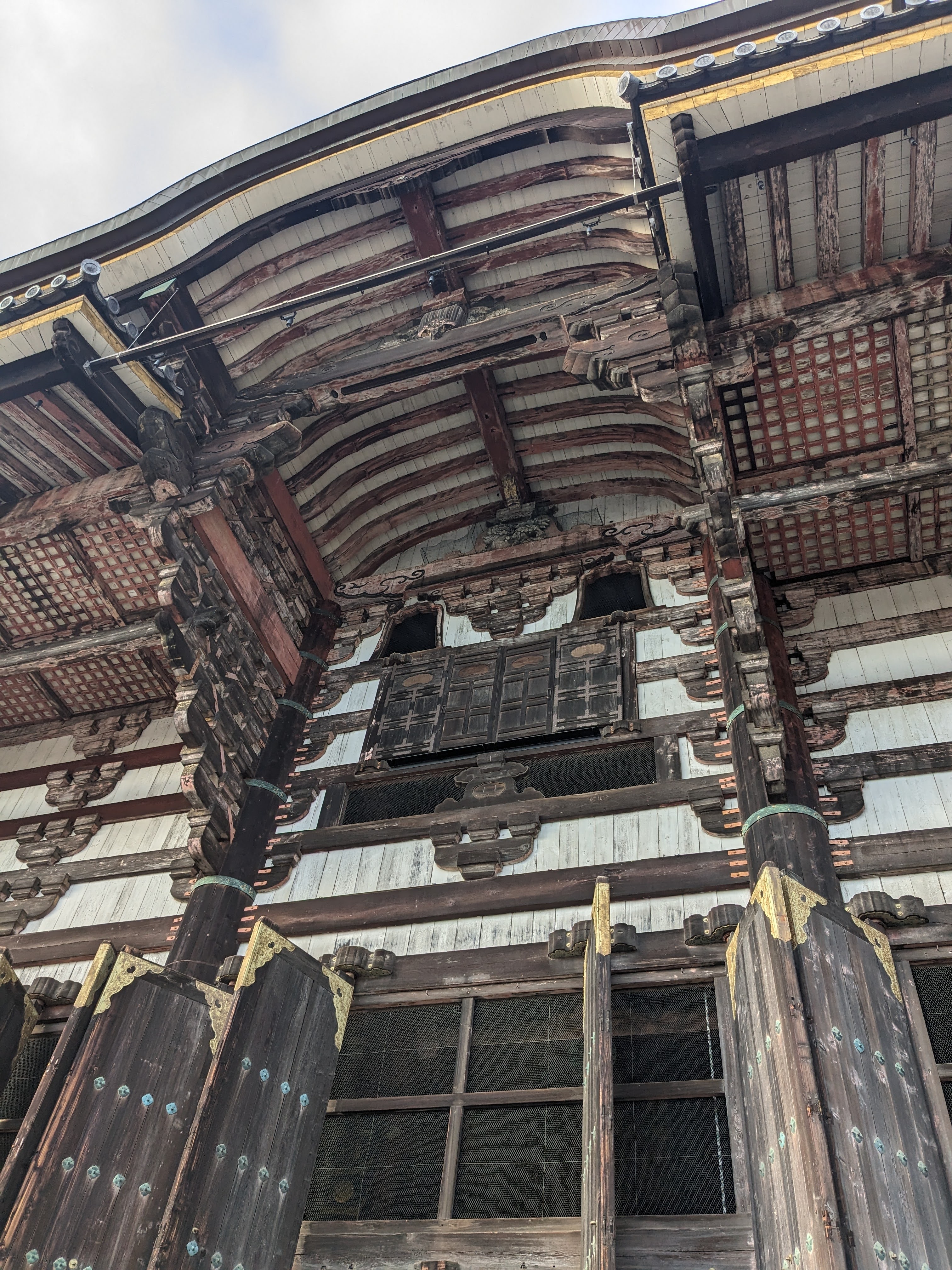 ▲ Interior ceiling and pillars
The exposed ceiling structure and vermilion columns. Centuries of wood darkened with time
▲ Interior ceiling and pillars
The exposed ceiling structure and vermilion columns. Centuries of wood darkened with time
Then the Rushana Buddha (Birushana Butsu) — the “Great Buddha.”
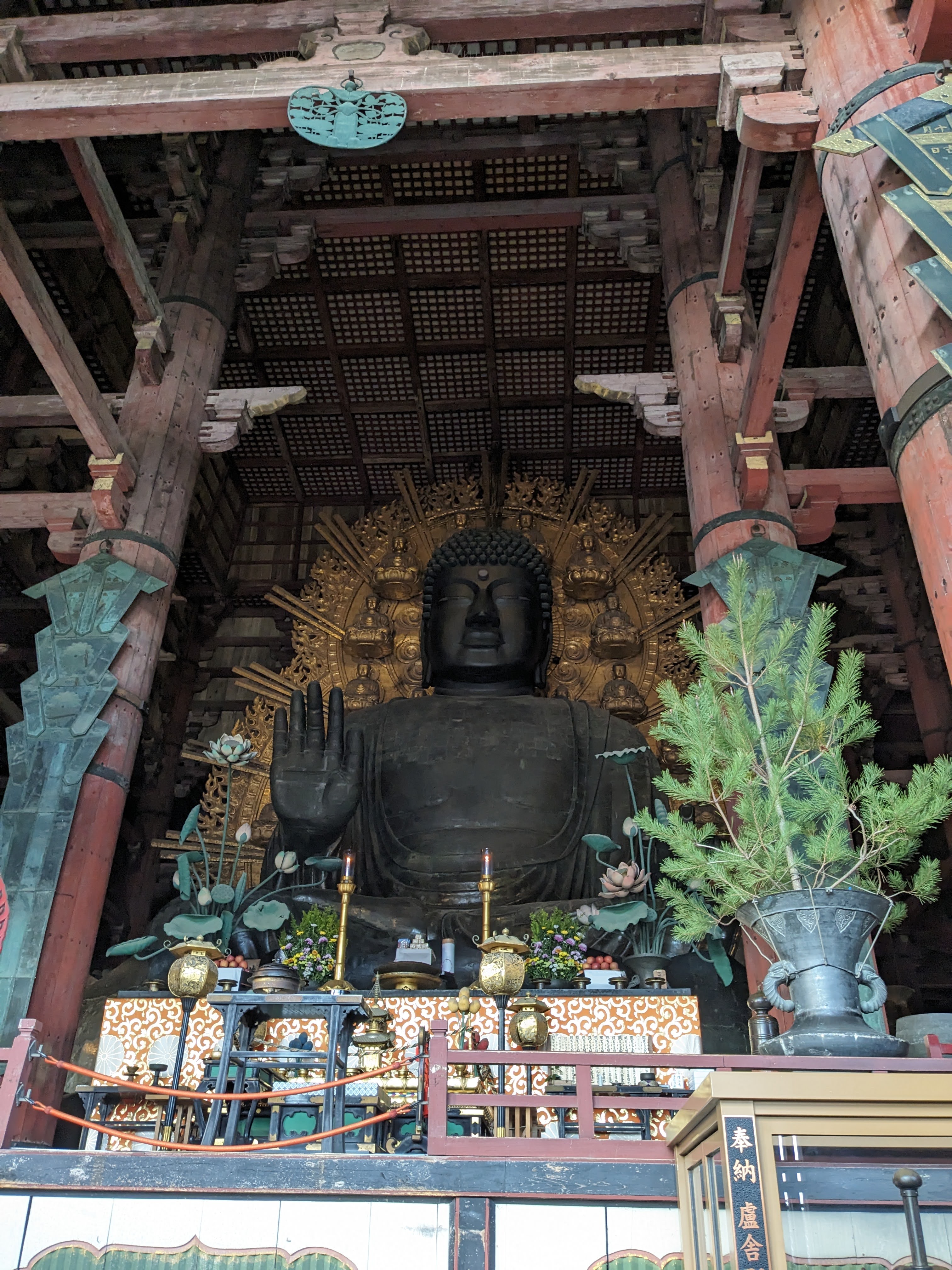 ▲ The Great Buddha, frontal view
14.7 meters tall. You have to tilt your head back quite far. Photos don’t capture the scale
▲ The Great Buddha, frontal view
14.7 meters tall. You have to tilt your head back quite far. Photos don’t capture the scale
The bronze has turned blue-green over the centuries. The expression is serene — unhurried in the way that very old things often are.
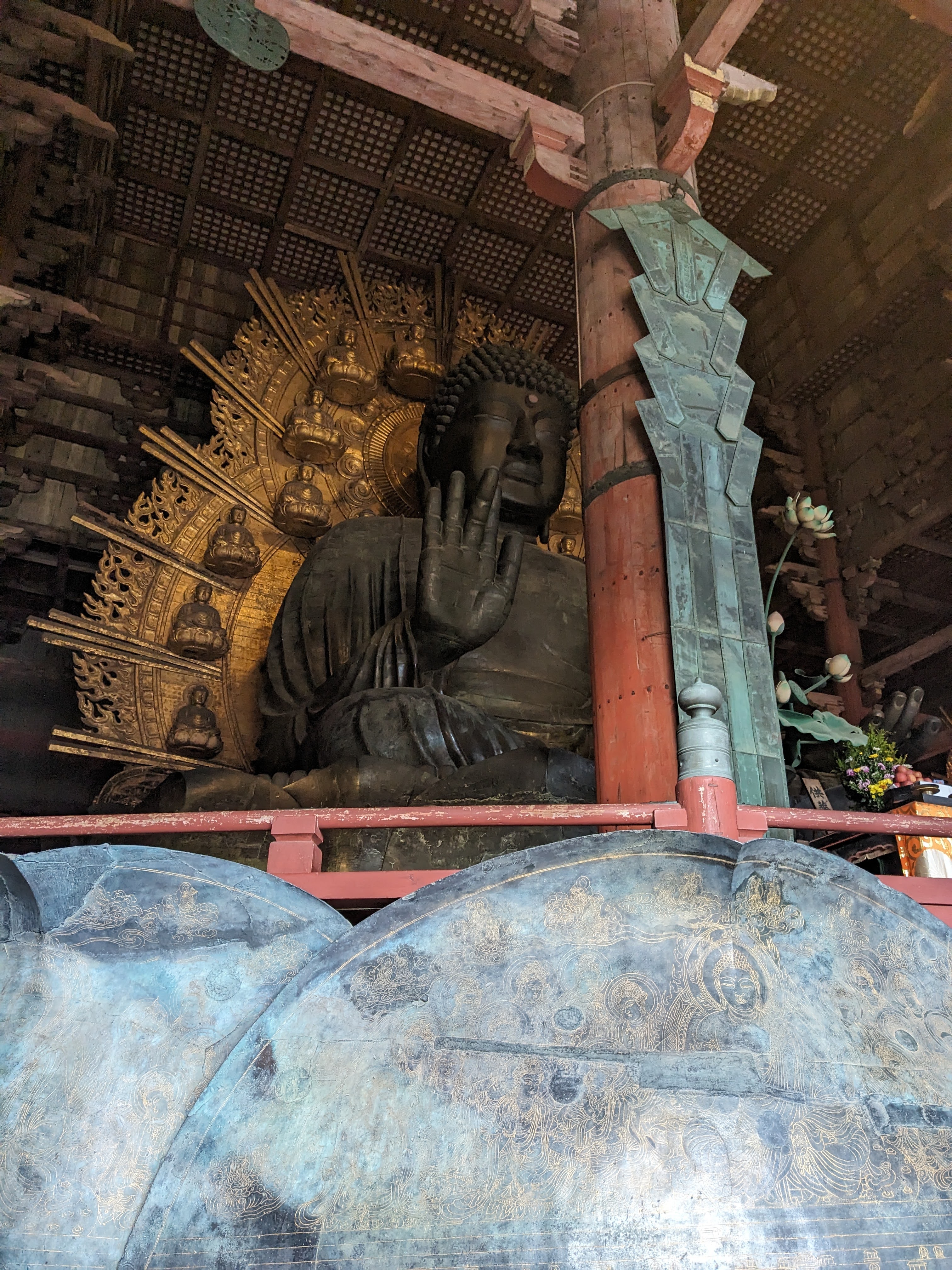 ▲ Great Buddha, side view
The lotus pedestal base is itself enormous. The whole thing together: almost impossible to process
▲ Great Buddha, side view
The lotus pedestal base is itself enormous. The whole thing together: almost impossible to process
Several other statues are displayed within the hall:
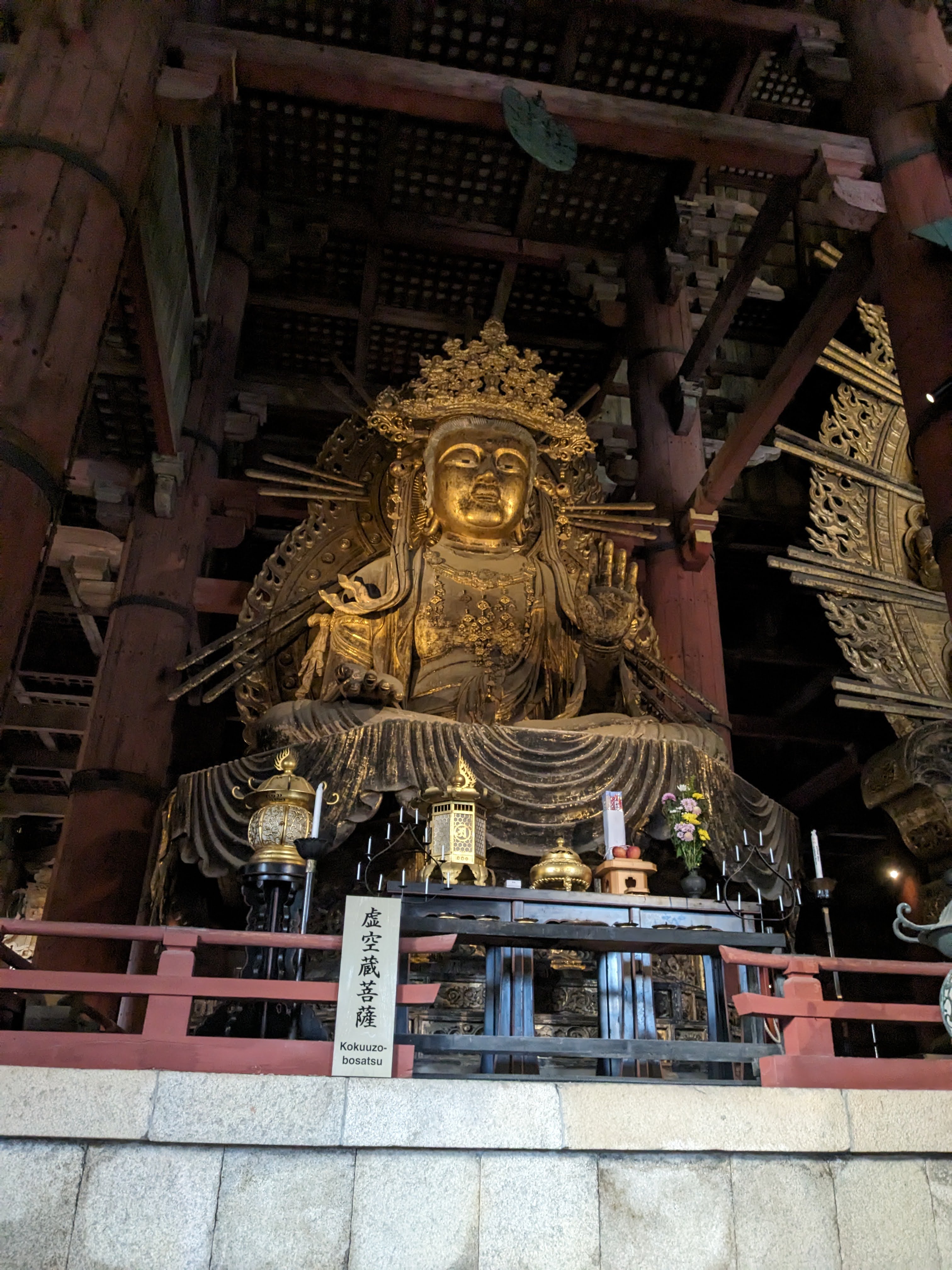 ▲ Kokuzo Bosatsu
Kokuzo Bosatsu (Akashagarbha), with an ornate gilded crown
▲ Kokuzo Bosatsu
Kokuzo Bosatsu (Akashagarbha), with an ornate gilded crown
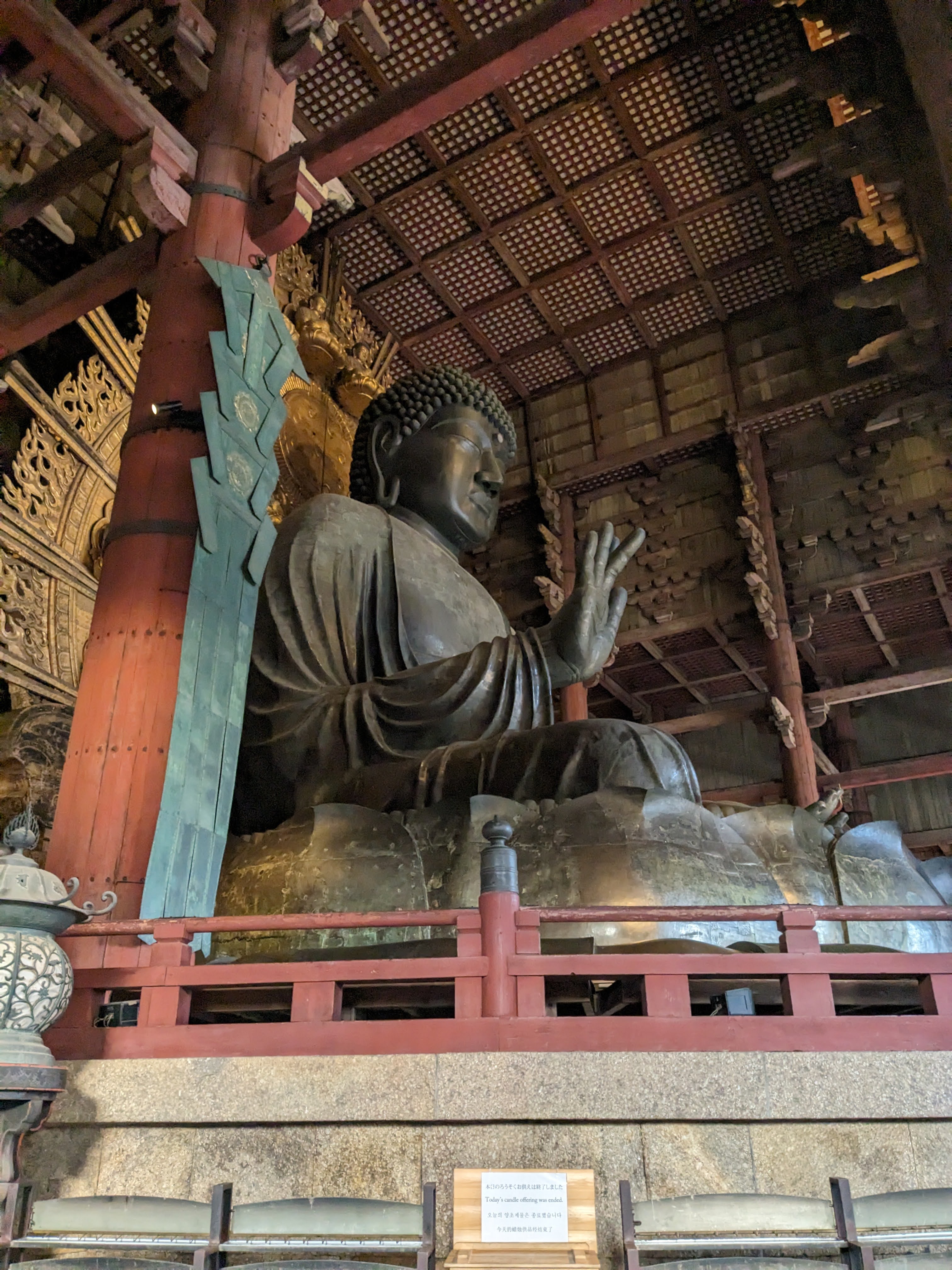 ▲ Great Buddha head close-up
Each of the spiral curls (rahotsu) on the Buddha’s head is said to be over 22cm wide
▲ Great Buddha head close-up
Each of the spiral curls (rahotsu) on the Buddha’s head is said to be over 22cm wide
Among the Four Heavenly Kings (Shitennō):
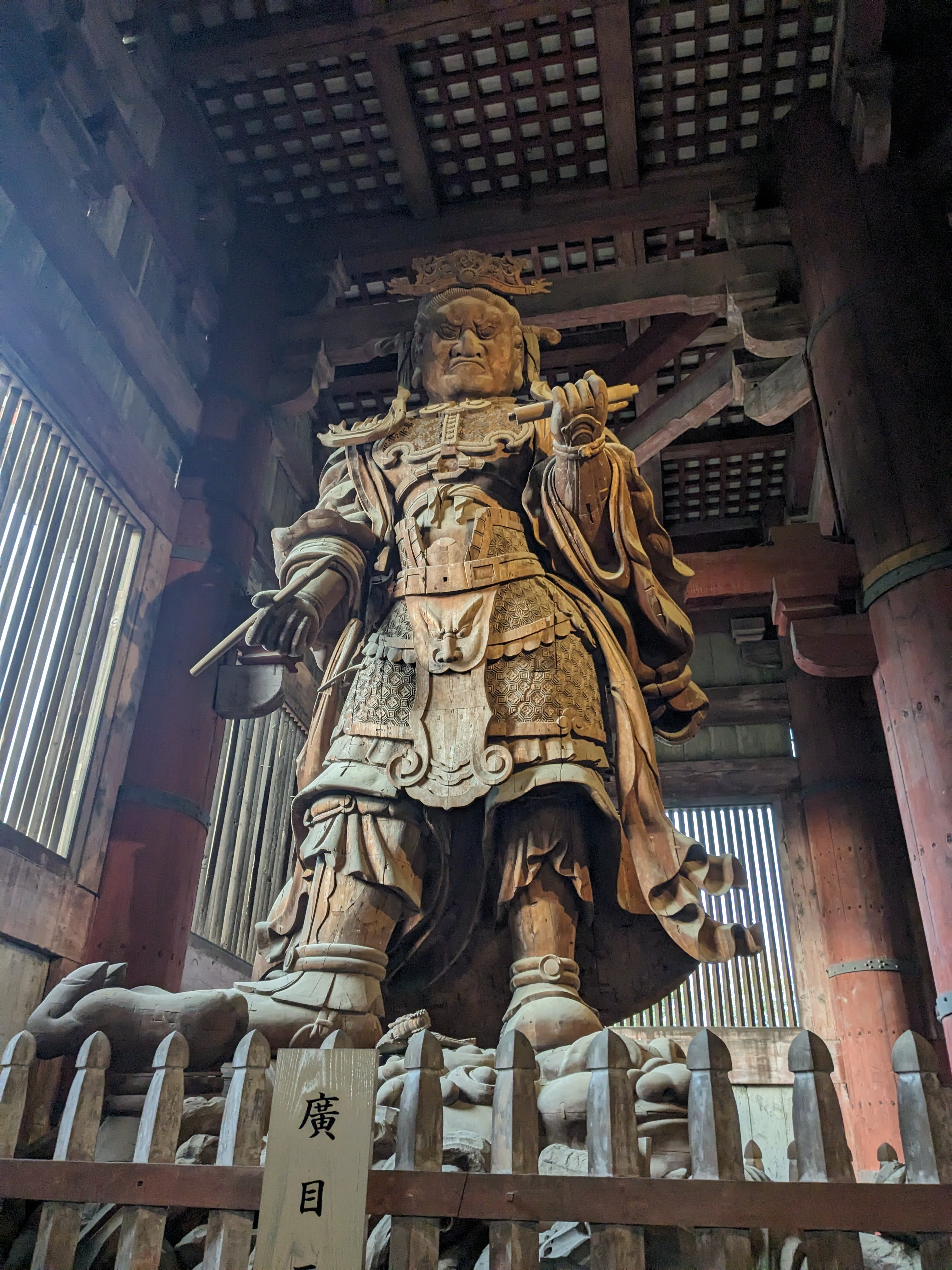 ▲ Kōmokuten (Four Heavenly Kings)
Kōmokuten — armored, fierce, with the Great Buddha looming above
▲ Kōmokuten (Four Heavenly Kings)
Kōmokuten — armored, fierce, with the Great Buddha looming above
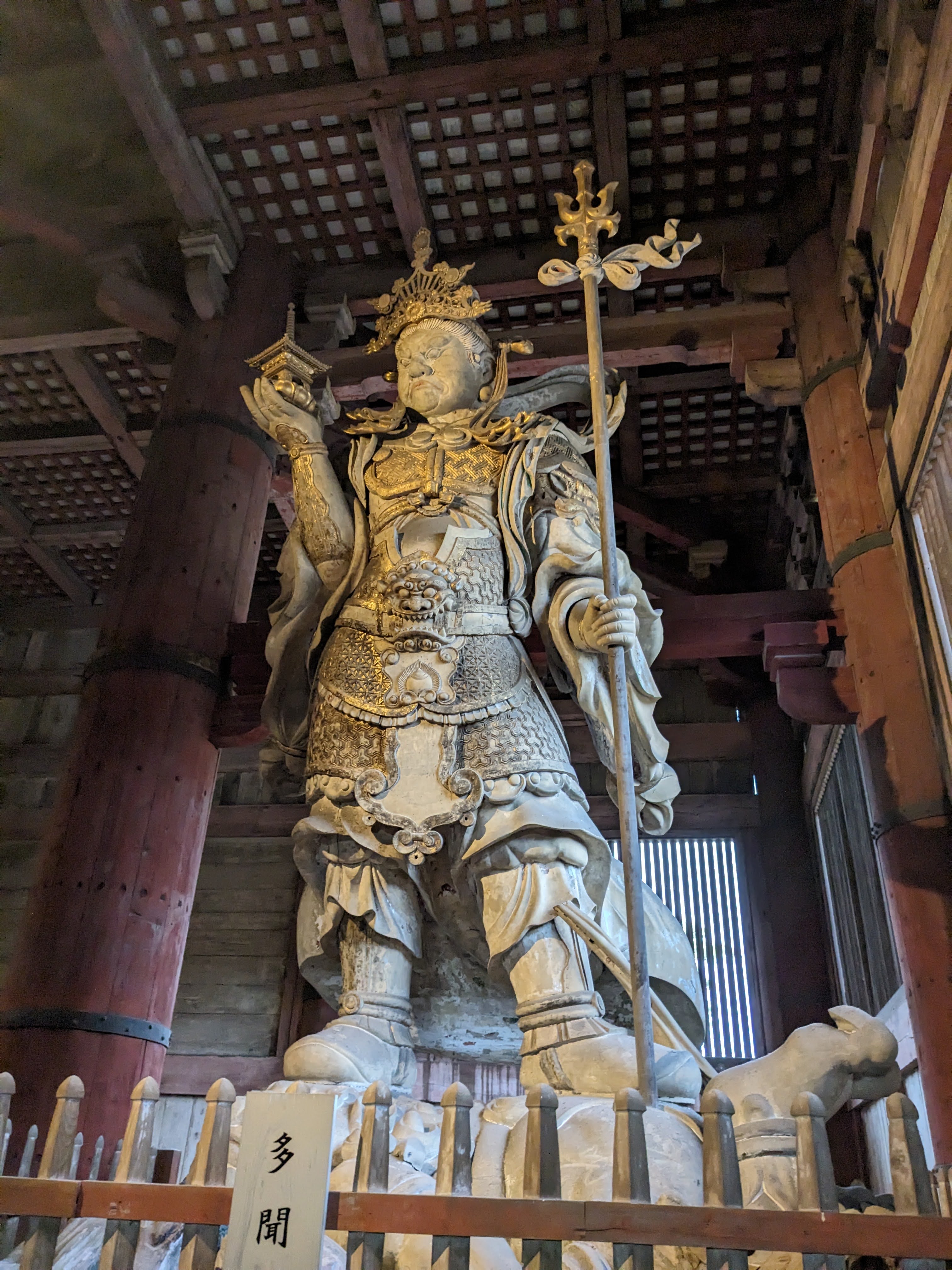 ▲ Tamonten (Four Heavenly Kings)
Tamonten (Bishamon), holding a miniature pagoda and a spear. His label reads simply “多聞” (Tamon)
▲ Tamonten (Four Heavenly Kings)
Tamonten (Bishamon), holding a miniature pagoda and a spear. His label reads simply “多聞” (Tamon)
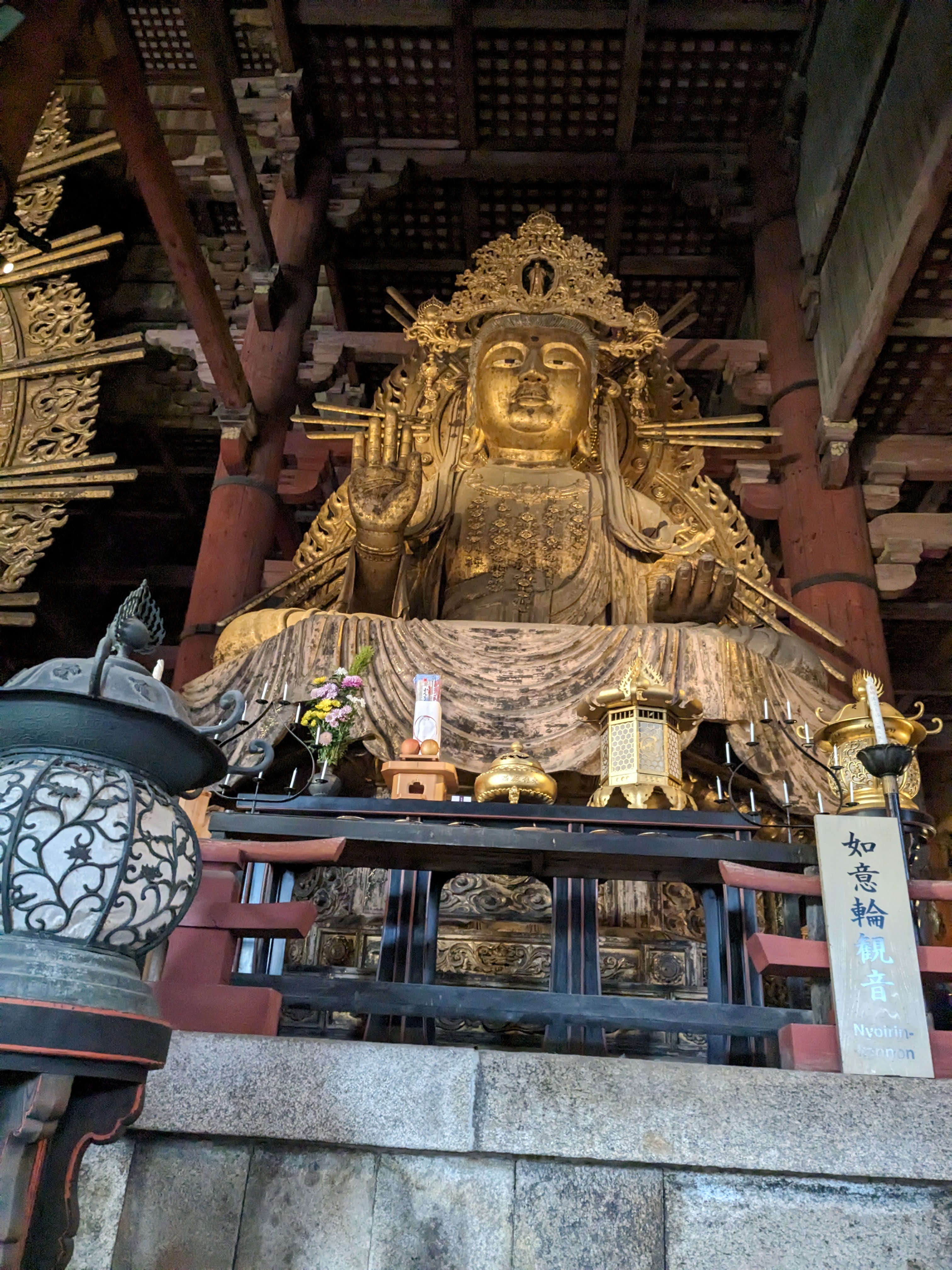 ▲ Nyoirin Kannon
Nyoirin Kannon — a multi-armed golden bodhisattva, the label identifying her clearly
▲ Nyoirin Kannon
Nyoirin Kannon — a multi-armed golden bodhisattva, the label identifying her clearly
And then there’s Binzuru Sonja — the “healing statue.”
 ▲ Binzuru Sonja (the rubbing Buddha)
Binzuru Sonja, wearing a red bib and cap. Tradition holds that rubbing the part of his body that corresponds to your ailment will heal you. Centuries of hands have worn the wood almost black. I rubbed his shoulder
▲ Binzuru Sonja (the rubbing Buddha)
Binzuru Sonja, wearing a red bib and cap. Tradition holds that rubbing the part of his body that corresponds to your ailment will heal you. Centuries of hands have worn the wood almost black. I rubbed his shoulder
Scale Models: Understanding Todaiji’s History in Three Dimensions
Inside the hall, scale models show how Todaiji looked in different eras.
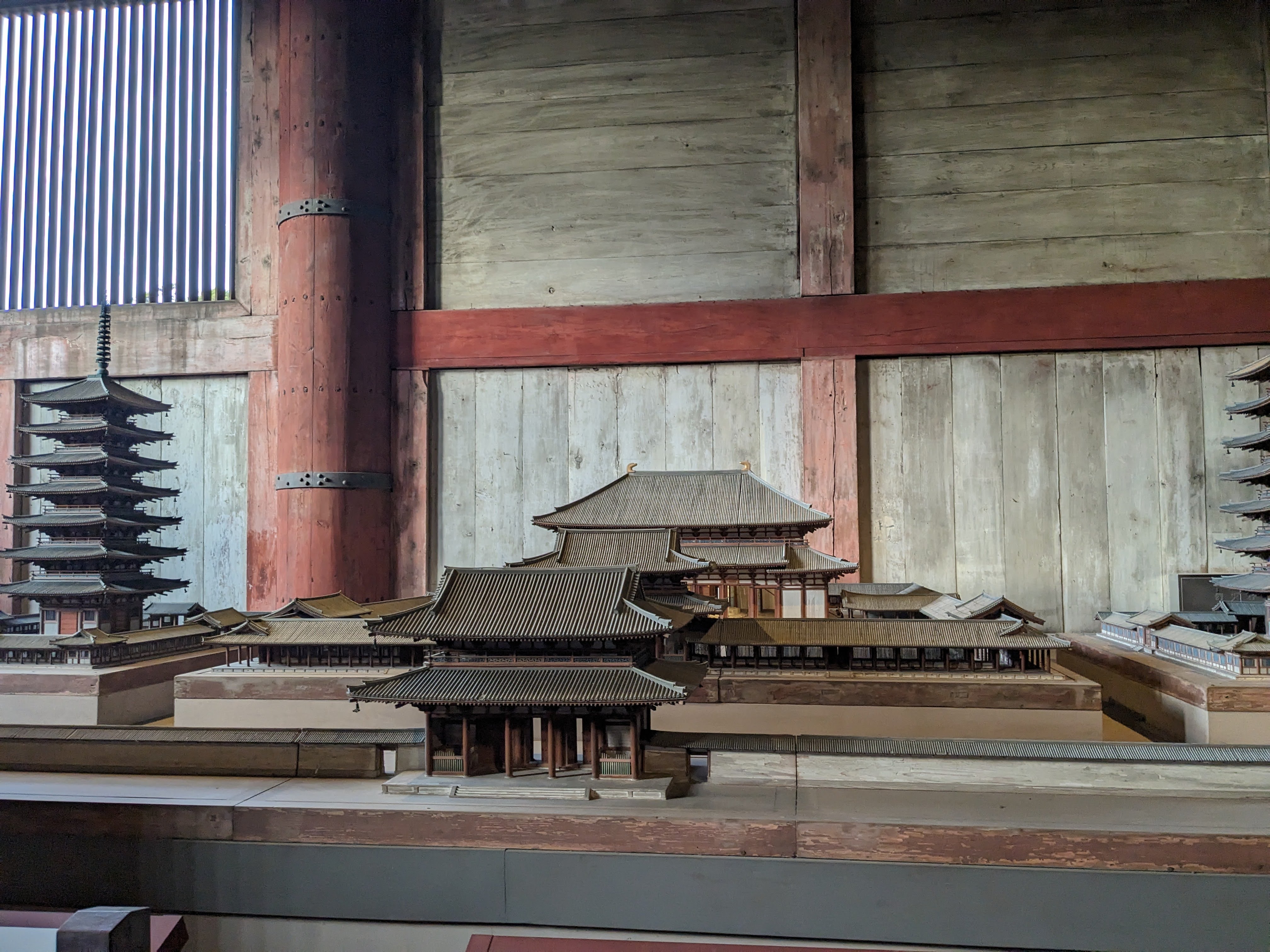 ▲ Scale model of the full Todaiji precinct
The original layout included twin seven-story pagodas, east and west. Almost nothing of that plan survives
▲ Scale model of the full Todaiji precinct
The original layout included twin seven-story pagodas, east and west. Almost nothing of that plan survives
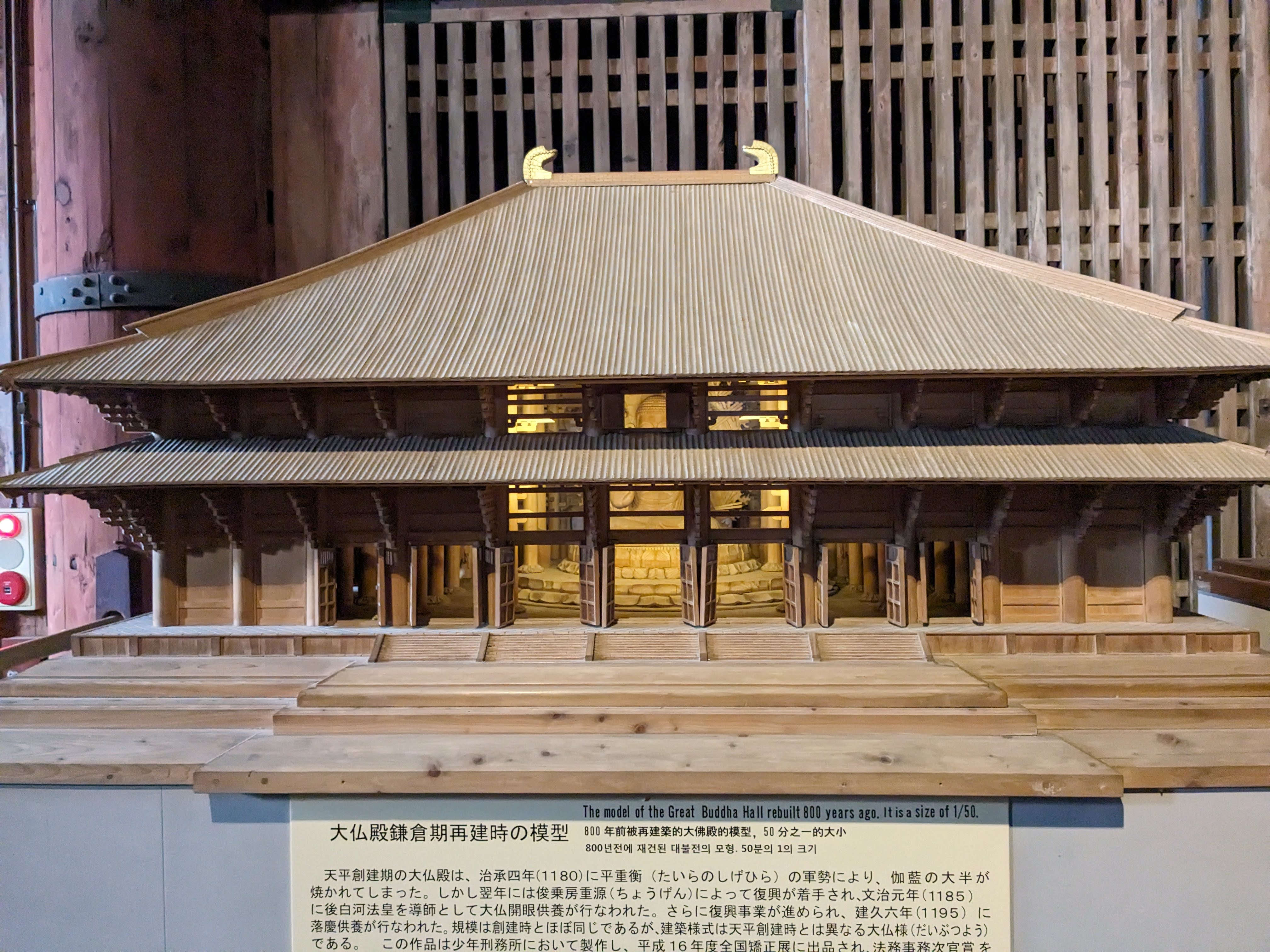 ▲ 1/50 scale model of Kamakura-era Daibutsuden
The Daibutsuden as rebuilt in the Kamakura period, about 800 years ago — at 1/50 scale. Larger and more symmetrical than today’s version
▲ 1/50 scale model of Kamakura-era Daibutsuden
The Daibutsuden as rebuilt in the Kamakura period, about 800 years ago — at 1/50 scale. Larger and more symmetrical than today’s version
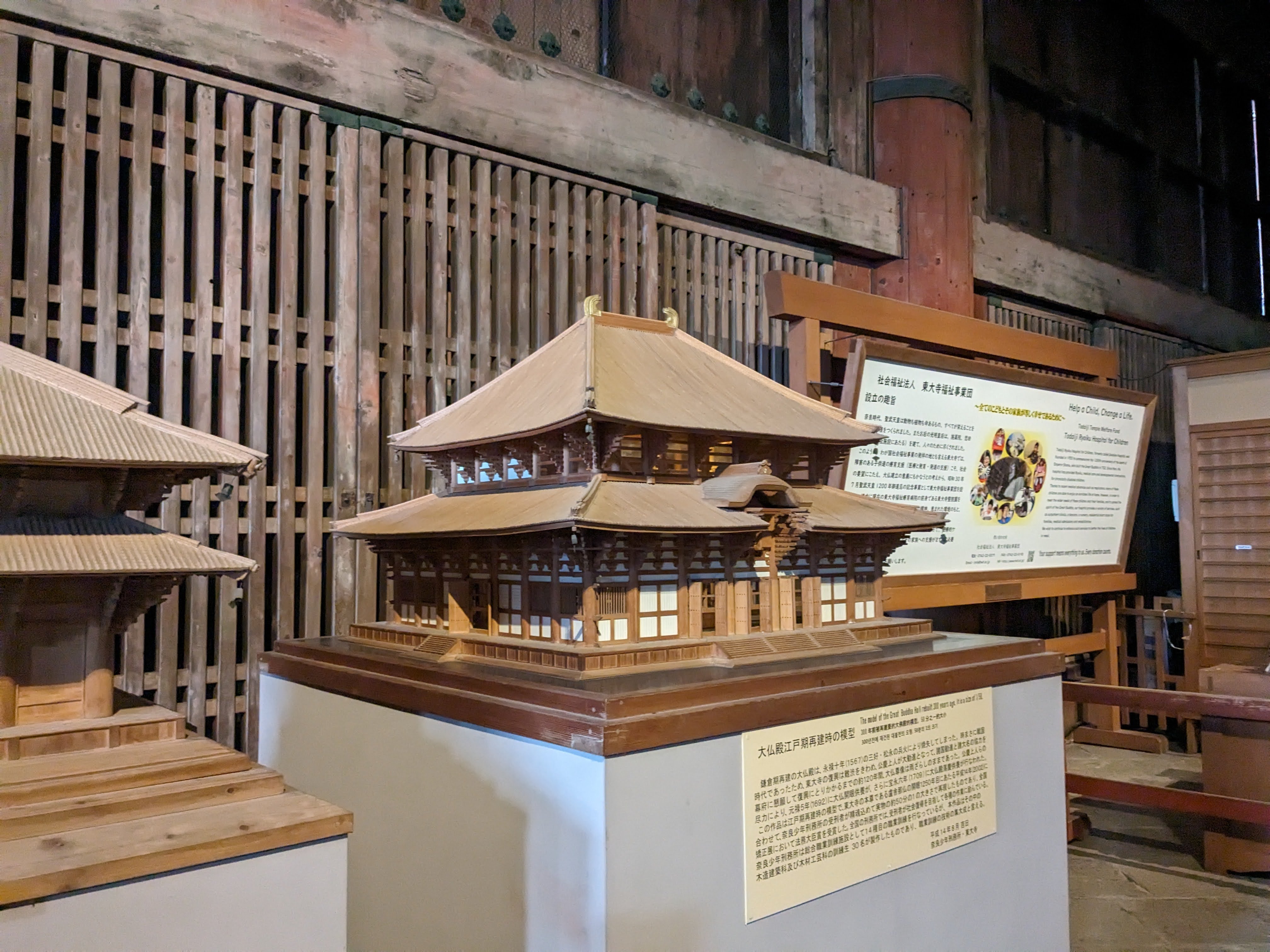 ▲ Edo-era reconstruction model
The Edo-period version, which is what stands today — slightly narrower due to budget and material constraints of the time
▲ Edo-era reconstruction model
The Edo-period version, which is what stands today — slightly narrower due to budget and material constraints of the time
Todaiji has been burned down twice and rebuilt each time. The models make that timeline tangible in a way that text alone cannot.
Contemporary Art in the Cloister
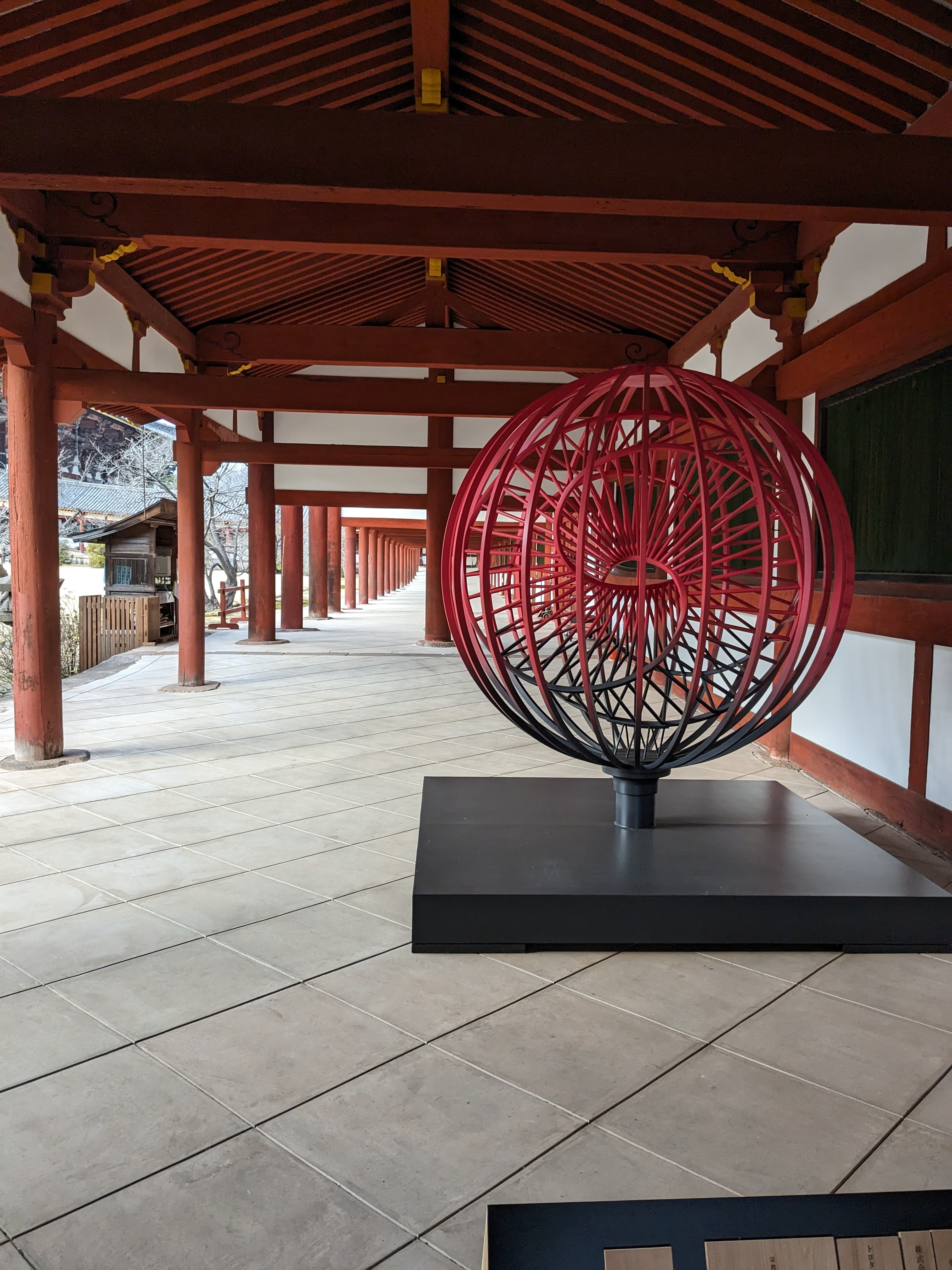
Exiting the hall into the covered corridor, I found a contemporary art installation — a large red geometric sphere on a black base.
 ▲ Contemporary art in the Todaiji cloister
Ancient wooden cloister, modern red sphere. The contrast was jarring in the best possible way
▲ Contemporary art in the Todaiji cloister
Ancient wooden cloister, modern red sphere. The contrast was jarring in the best possible way
Kasuga Taisha Area: Torii and Stone Lanterns at Dusk
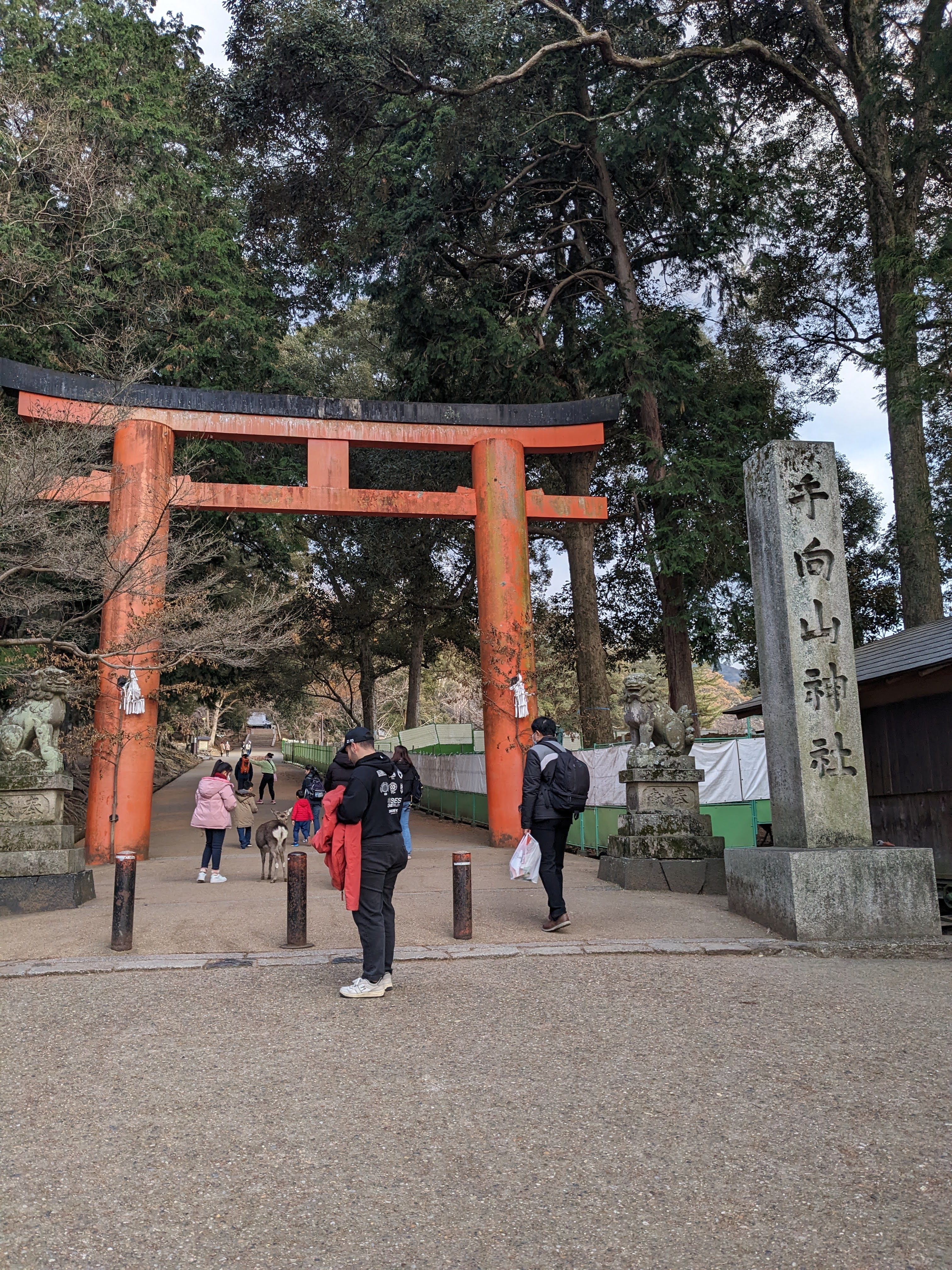
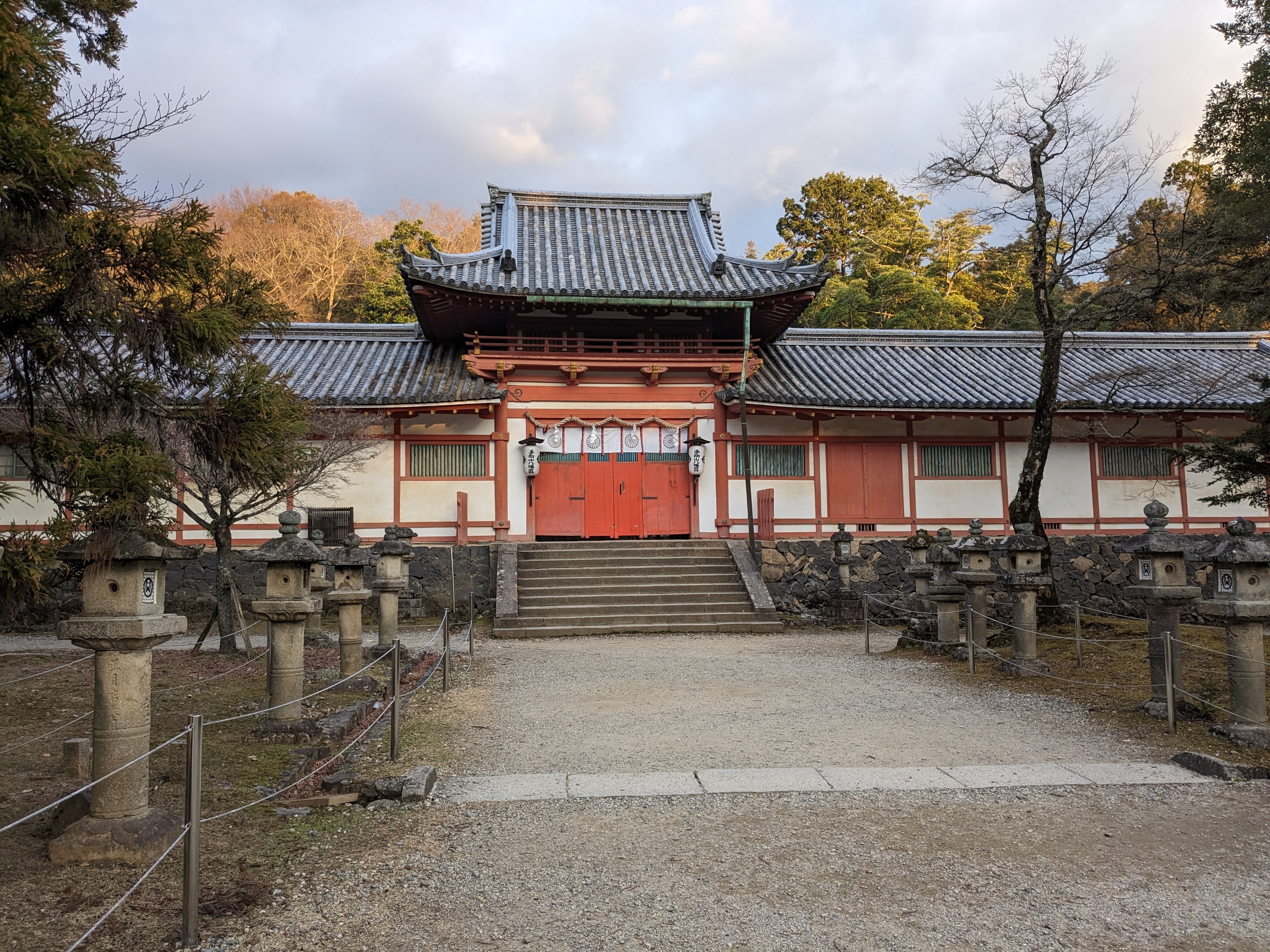
From Todaiji, I walked toward the Kasuga Taisha area. The light was already turning warm and golden.
 ▲ Large torii gate near Kasuga Taisha
A vermilion torii at the edge of the park. More deer, inevitably
▲ Large torii gate near Kasuga Taisha
A vermilion torii at the edge of the park. More deer, inevitably
 ▲ Shrine gate with stone lanterns
A sub-shrine gate lined with stone lanterns. The evening light caught the tiles beautifully
▲ Shrine gate with stone lanterns
A sub-shrine gate lined with stone lanterns. The evening light caught the tiles beautifully
Nigatsu-do: Climbing to the Sunset View
From the Kasuga area, I made my way toward Nigatsu-do (Second Month Hall), one of Todaiji’s sub-halls built on a hillside above the main complex. It’s known for the annual Omizutori (water-drawing ceremony) in March, and for its stunning panoramic view.
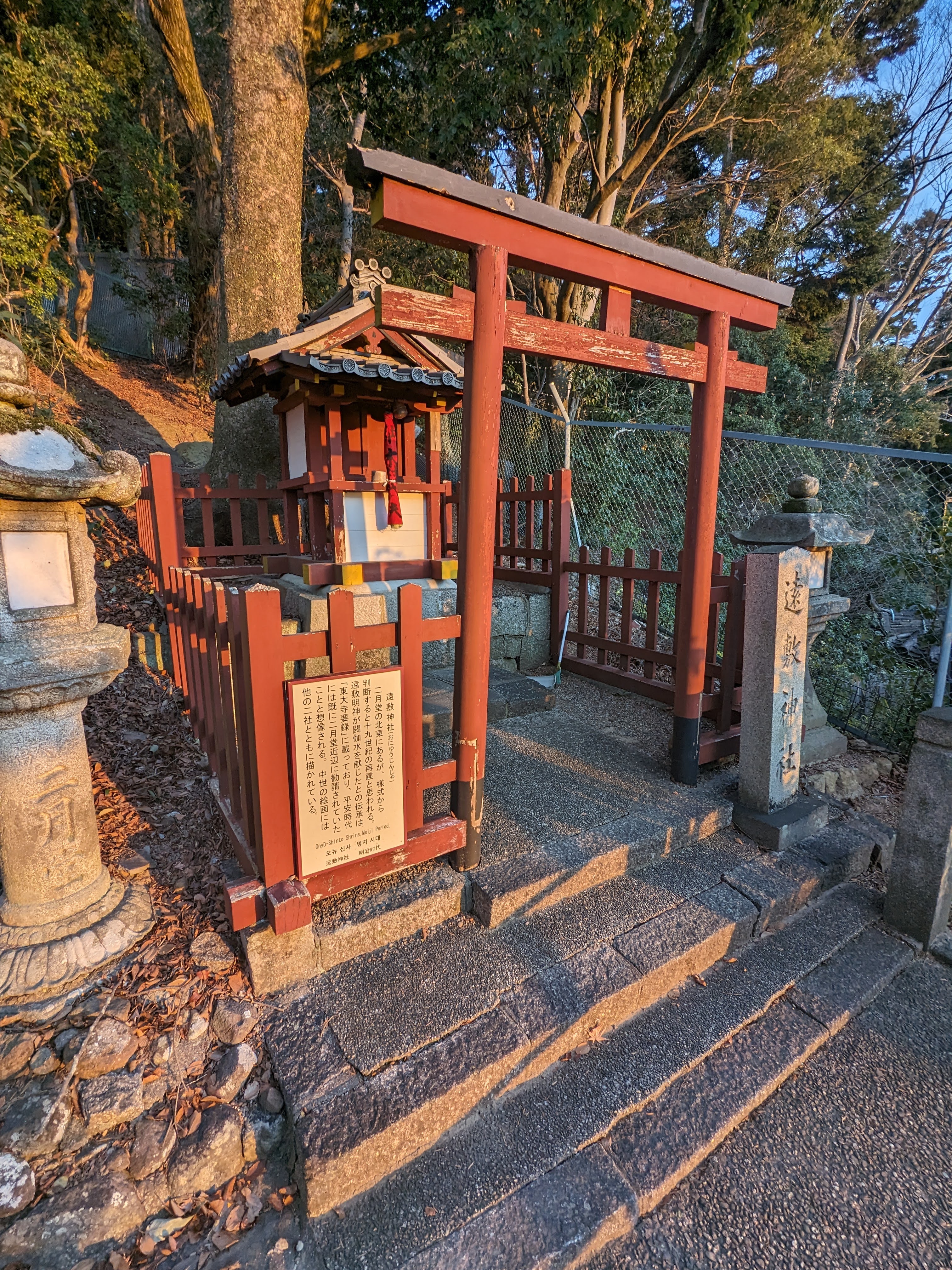
The approach involves a narrow gravel path winding up through trees.
 ▲ Small roadside shrine on the path to Nigatsu-do
A tiny vermilion shrine on the hillside path. Easy to walk past without noticing
▲ Small roadside shrine on the path to Nigatsu-do
A tiny vermilion shrine on the hillside path. Easy to walk past without noticing
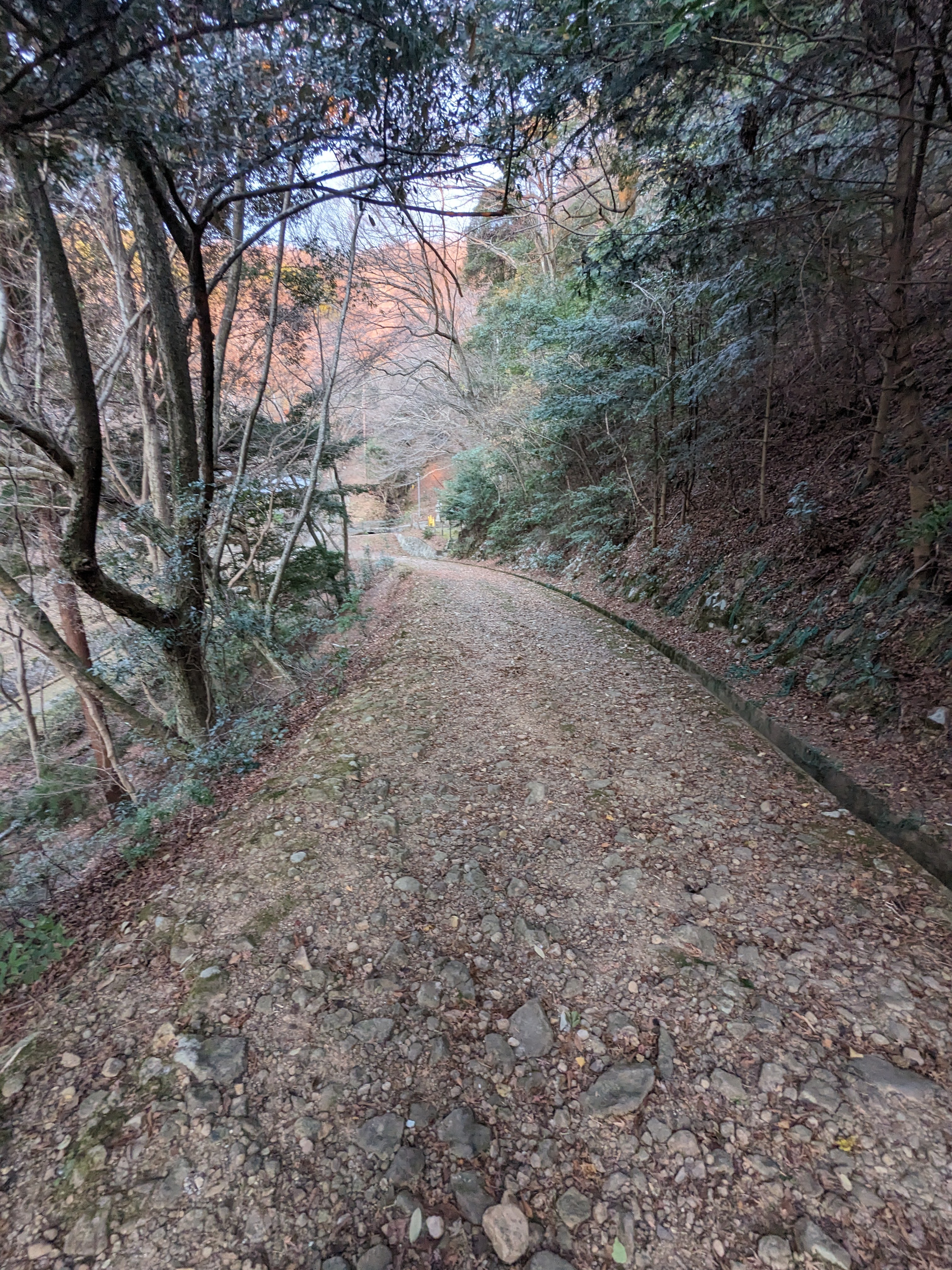 ▲ Path through the woods
The gravel path up to Nigatsu-do, quiet and shadowed in the late afternoon
▲ Path through the woods
The gravel path up to Nigatsu-do, quiet and shadowed in the late afternoon
At the top, Nigatsu-do itself:
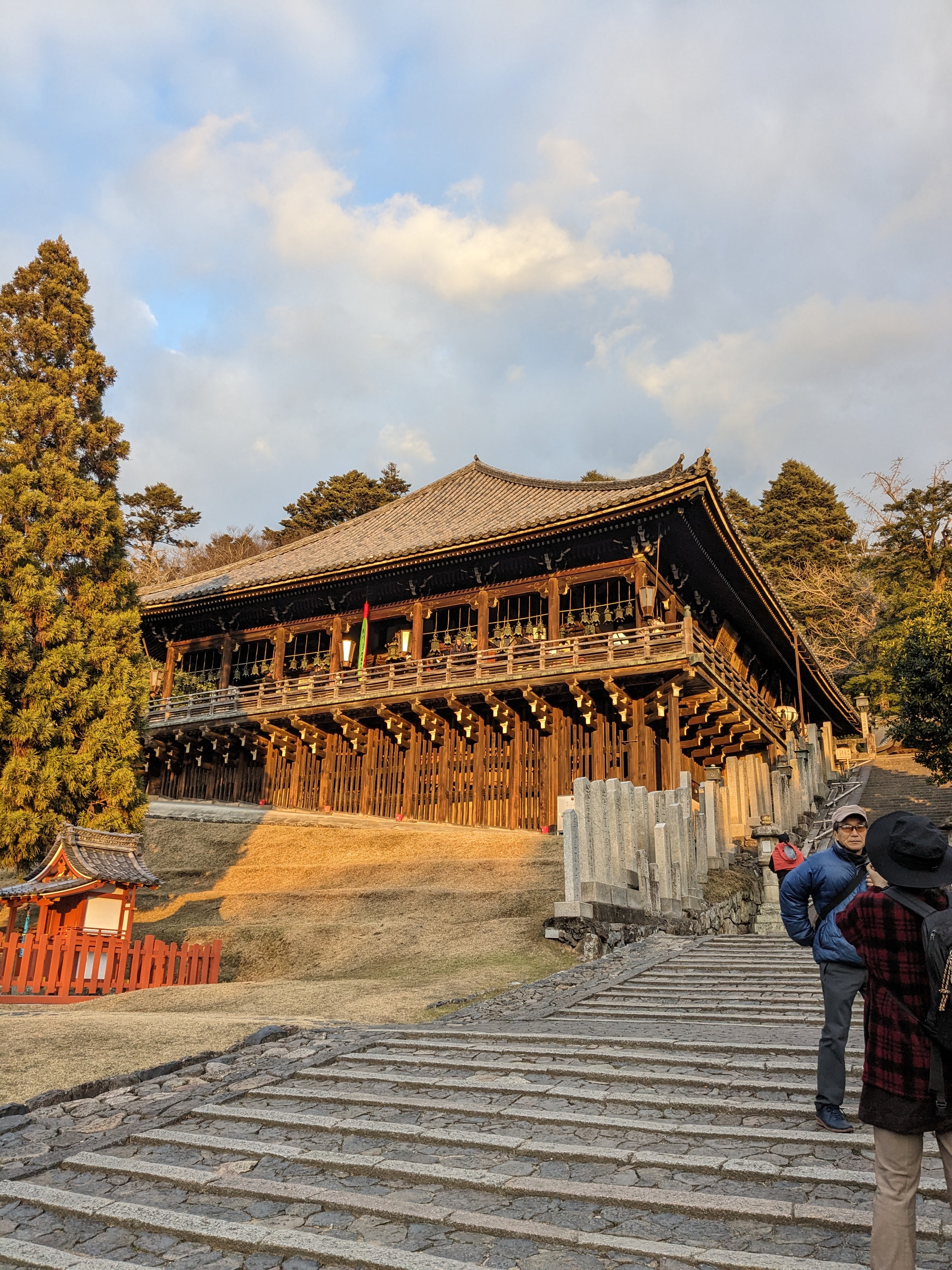 ▲ Nigatsu-do from below
Nigatsu-do, its balcony projecting over the hillside. Stone steps lead up steeply
▲ Nigatsu-do from below
Nigatsu-do, its balcony projecting over the hillside. Stone steps lead up steeply
Then, at dusk, through the historic lanes leading to the viewpoint:
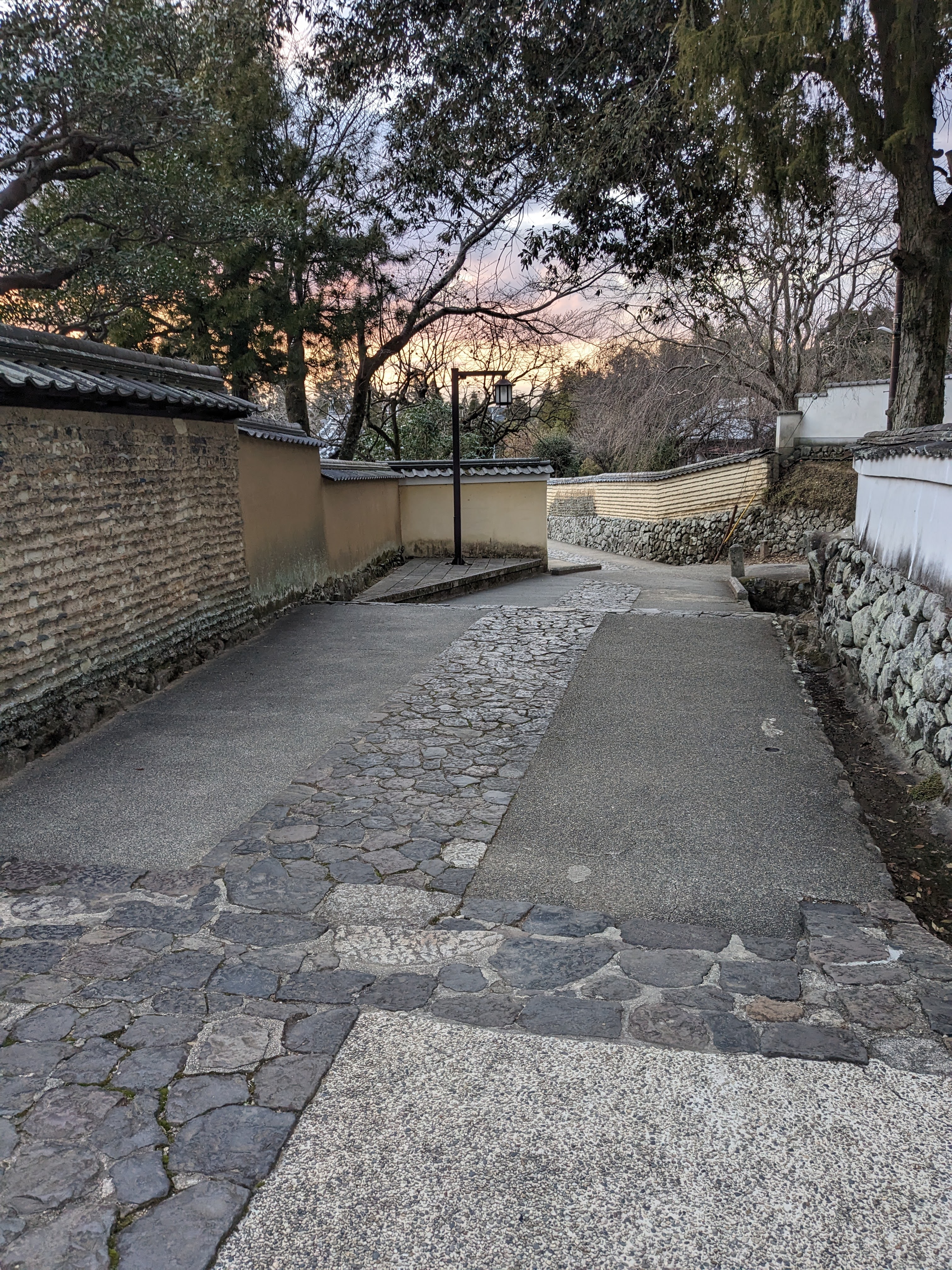 ▲ Evening alley near Nigatsu-do
Stone-paved path between plaster walls. The sky was already turning pink
▲ Evening alley near Nigatsu-do
Stone-paved path between plaster walls. The sky was already turning pink
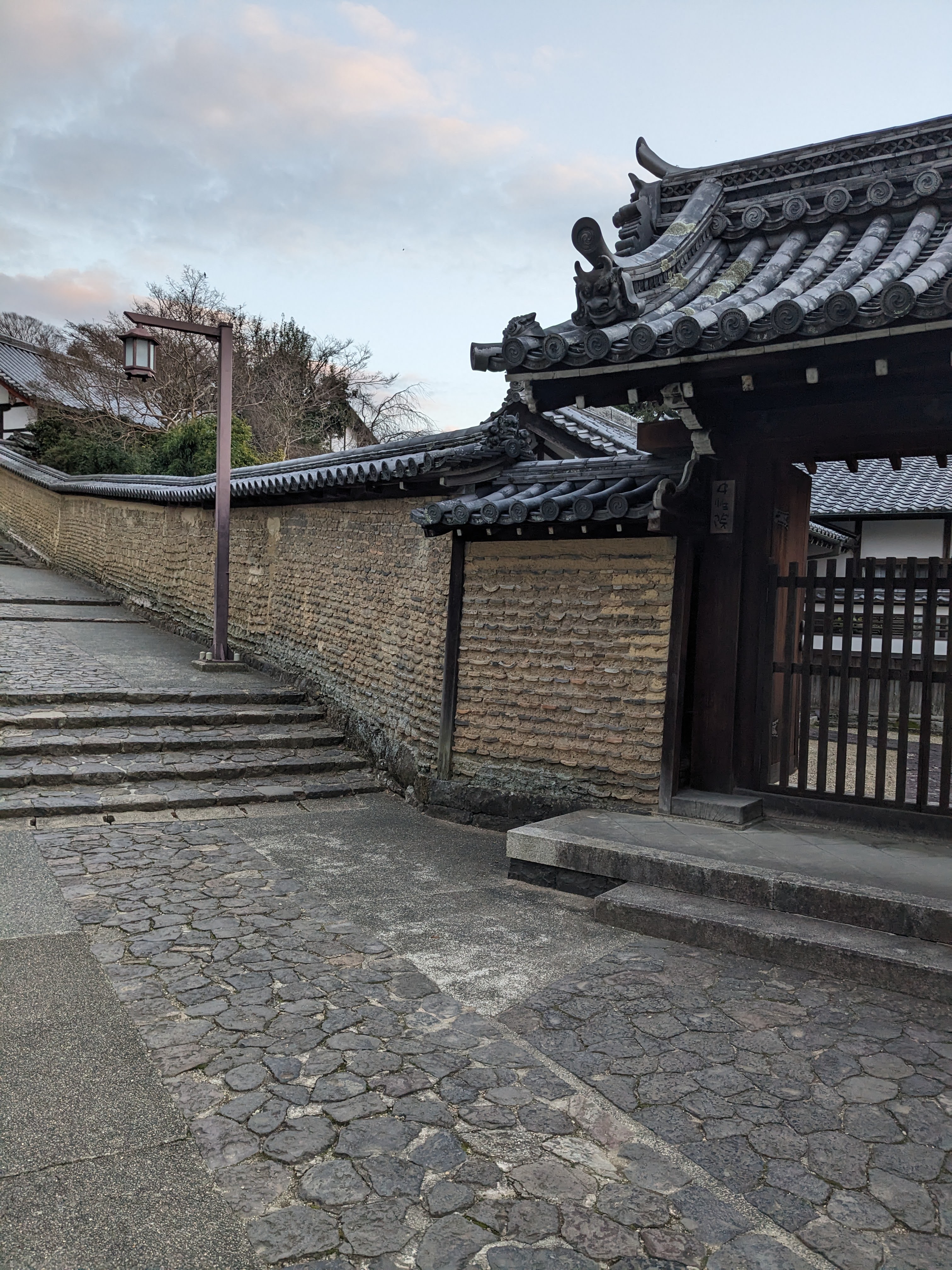 ▲ Temple gate at dusk
A gate with elaborate demon-face roof tiles, silhouetted against the fading sky
▲ Temple gate at dusk
A gate with elaborate demon-face roof tiles, silhouetted against the fading sky
And then, standing on the Nigatsu-do platform:
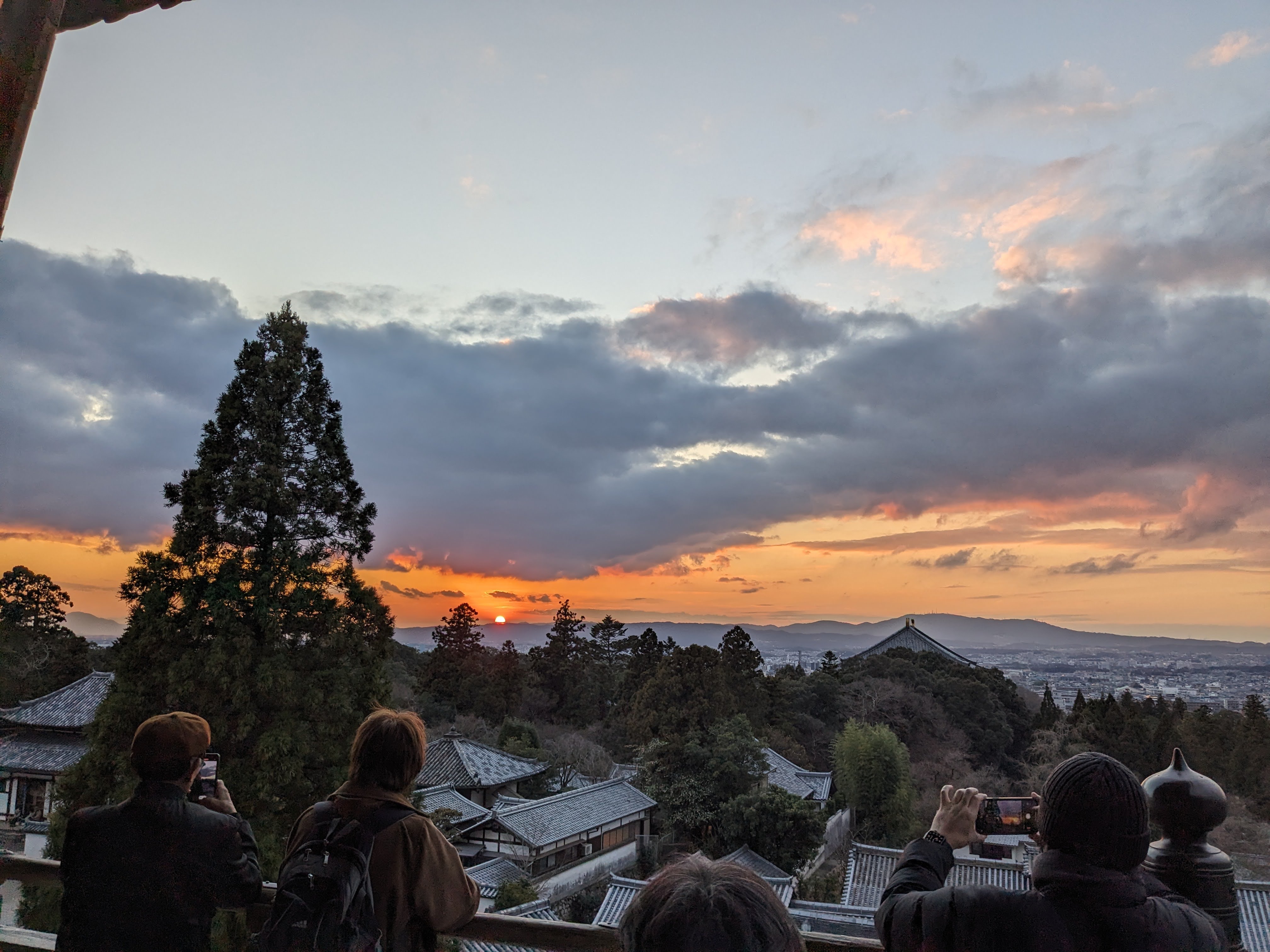 ▲ Sunset view from Nigatsu-do
The sun dropping behind the mountains west of Nara. Nara’s city rooflines below, the distant ranges silhouetted against orange sky. Every person on the platform was silent and pointing a camera. This view is the reason to come
▲ Sunset view from Nigatsu-do
The sun dropping behind the mountains west of Nara. Nara’s city rooflines below, the distant ranges silhouetted against orange sky. Every person on the platform was silent and pointing a camera. This view is the reason to come
Winter sunsets in Nara are early and dramatic. This one, at the tail end of December, was everything.
Naramachi: Old Townhouses at Night
I descended from Nigatsu-do and made my way to Naramachi, Nara’s historic merchant district. The streets are lined with lattice-windowed machiya townhouses from the Edo and Meiji periods.
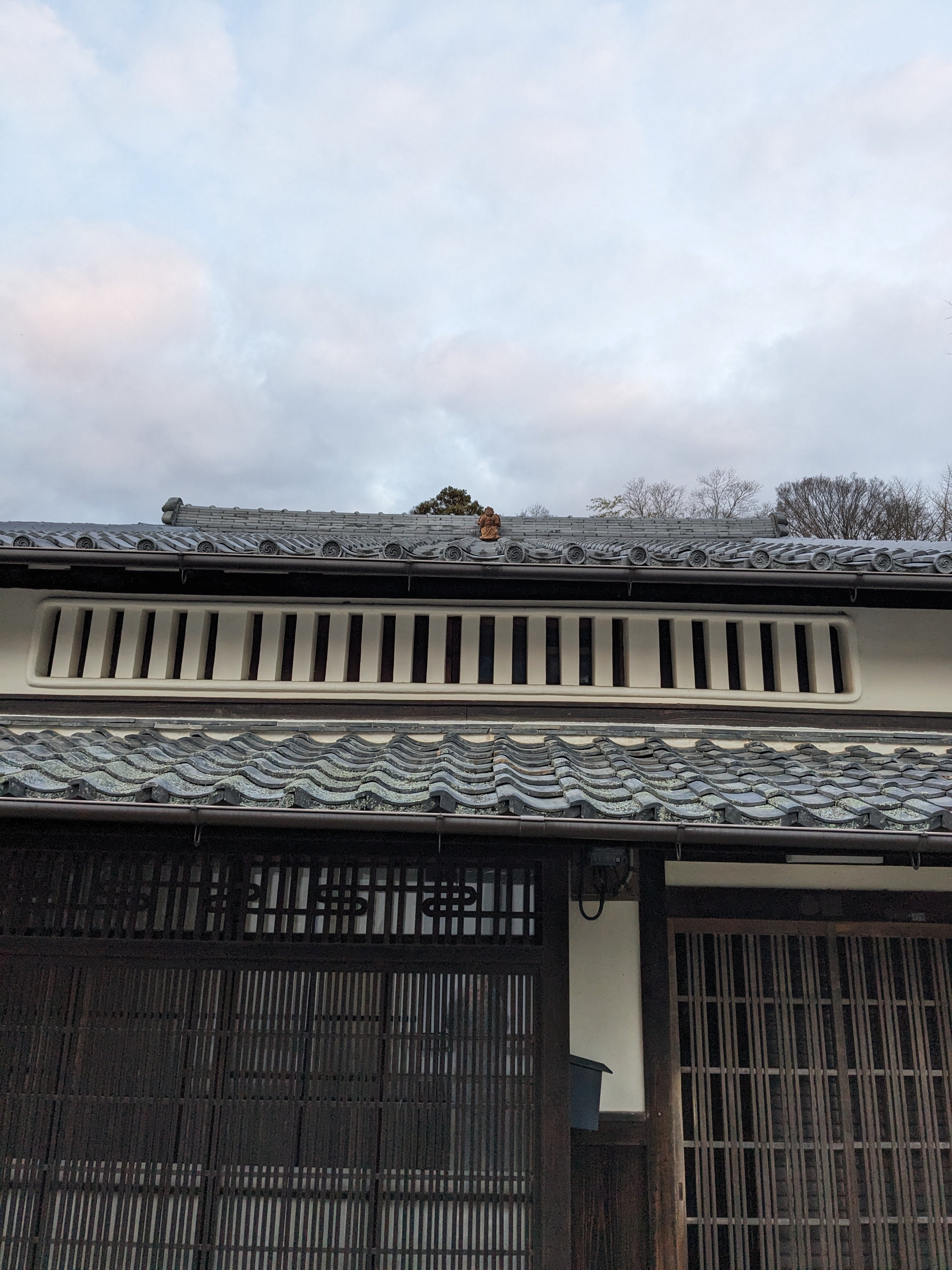 ▲ Naramachi machiya townhouse
A machiya facade in Naramachi. Look closely at the roof: a small Buddha figure sits atop the ridge tiles
▲ Naramachi machiya townhouse
A machiya facade in Naramachi. Look closely at the roof: a small Buddha figure sits atop the ridge tiles
Walking those quiet streets after dark, I could still feel the day in my legs — all those stone paths, temple approaches, and hillside climbs. Worth every step.
Nara in Winter: Final Thoughts
The December timing was a genuine advantage. Crowds were light. The Great Buddha Hall was spacious and unhurried. The sunset from Nigatsu-do was a reward I hadn’t fully anticipated.
Highlights of the day:
- Nandaimon Nio guardians — 800-year-old Kamakura realism, still electrifying
- The Great Buddha — 14.7 meters of calm, ancient presence
- Binzuru Sonja — rubbed the shoulder; we’ll see
- Nigatsu-do sunset — the kind of view that makes you stop talking
- Naramachi — machiya streetscapes after dark
For anyone visiting Nara: a weekday in December or January gives you these sights mostly to yourself. Come for the Great Buddha; stay for the sunset.
→ Practical travel info: Nara Day Trip Guide (access, costs, model itinerary)
Related Articles
Find Hotels in Nara
PR: Contains Rakuten Travel affiliate link.
▶ Find hotels and ryokan in Nara on Rakuten Travel
